Quote
"Another lesson to be learned, to continue using my oceanographic metaphor, is that while you are swimming and not sinking you should aim for rough water."
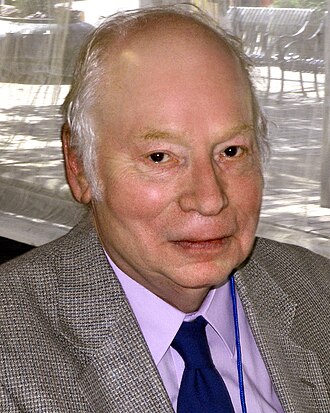 Steven Weinberg
Steven Weinberg
Steven Weinberg
Steven Weinberg was an American theoretical physicist. He shared the 1979 Nobel Prize in Physics with Abdus Salam and Sheldon Glashow "for their contributions to the theory of the unified weak and electromagnetic interaction between elementary particles, including, inter alia, the prediction of the weak neutral current".
"Another lesson to be learned, to continue using my oceanographic metaphor, is that while you are swimming and not sinking you should aim for rough water."
Steven Weinberg"To start, we will consider a single particle moving in three space dimensions under the influence of a general central potential. Later we will specialize to the case of a Coulomb potential, and work out the spectrum of hydrogen. One other classic problem, the harmonic oscillator, will be treated at the end of this chapter."
Steven Weinberg"I managed to get a quick PhD — though when I got it I knew almost nothing about physics. But I did learn one big thing: that no one knows everything, and you dont have to."
Steven Weinberg"Elementary particles are terribly boring, which is one reason why were so interested in them."
Steven Weinberg"One of the great achievements of science has been, if not to make it impossible for intelligent people to be religious, then at least to make it possible for them not to be religious. We should not retreat from this accomplishment."
Steven Weinberg"If you have bought one of those T-shirts with Maxwells equations on the front, you may have to worry about its going out of style, but not about its becoming false. We will go on teaching Maxwellian electrodynamics as long as there are scientists."
Steven Weinberg"So what happens to the effective field theories of electroweak, strong, and gravitational interactions at energies of order 1015–1018 GeV? I know of only two plausible alternatives. One possibility is that the theory remains a quantum field theory, but one in which the finite or infinite number of renormalized couplings do not run off to infinity with increasing energy, but hit a fixed point of the renormalizable group equations. ... The other possibility, which I have to admit is a priori more likely, is that at very high energy we will run into really new physics, not describable in terms of a quantum field theory. I think that by far the most likely possibility is that this will be something like a string theory."
Steven Weinberg"It seems to me that we are in the position of a company of players who have by chance found their way into a great theater. Outside, the city streets are dark and lifeless, but in the theater the lights are on, the air is warm, and the walls are wonderfully decorated. However, no scripts are found, so the players begin to improvise—a little psychological drama, a little poetry, whatever comes to mind. Some even set themselves to explain the stage machinery. The players do not forget that they are just amusing themselves, and that they will have to return to the darkness outside the theater, but while on the stage they do their best to give a good performance. I suppose that this is a rather melancholy view of human life, but melancholy is one of the distinctive creations of our species, and not without its own consolations."
Steven Weinberg"It seems that scientists are often attracted to beautiful theories in the way that insects are attracted to flowers — not by logical deduction, but by something like a sense of smell."
Steven Weinberg"There are those whose views about religion are not very different from my own, but who nevertheless feel that we should try to damp down the conflict, that we should compromise it. … I respect their views and I understand their motives, and I dont condemn them, but Im not having it. To me, the conflict between science and religion is more important than these issues of science education or even environmentalism. I think the world needs to wake up from its long nightmare of religious belief; and anything that we scientists can do to weaken the hold of religion should be done, and may in fact be our greatest contribution to civilization."
Steven Weinberg"In trying to get votes for the Superconducting Super Collider, I was very much involved in lobbying members of Congress, testifying to them, bothering them, and I never heard any of them talk about postmodernism or social constructivism. You have to be very learned to be that wrong."
Steven Weinberg"There’s something I’ve been working on for more than a year — maybe it’s just an old man’s obsession, but I’m trying to find an approach to quantum mechanics that makes more sense than existing approaches. I’ve just finished editing the second edition of my book, Lectures on Quantum Mechanics, in which I think I strengthen the argument that none of the existing interpretations of quantum mechanics are entirely satisfactory."
Steven Weinberg




