Quote
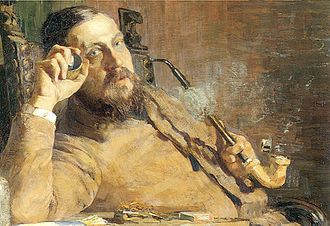
"I forswore my model, Beethoven; his last Symphony I deemed the keystone of a whole great epoch of art, beyond whose limits no man could hope to press, and within which no man could attain to independence."
 Symphony No. 9 (Beethoven)
Symphony No. 9 (Beethoven)
Symphony No. 9 (Beethoven)
The Symphony No. 9 in D minor, Op. 125, is a choral symphony, the final complete symphony by Ludwig van Beethoven, composed between 1822 and 1824. It was first performed in Vienna on 7 May 1824. The symphony is regarded by many critics and musicologists as a masterpiece of Western classical music and one of the supreme achievements in the history of music. One of the best-known works in common pra
"I forswore my model, Beethoven; his last Symphony I deemed the keystone of a whole great epoch of art, beyond whose limits no man could hope to press, and within which no man could attain to independence."
Symphony No. 9 (Beethoven)"O Freunde, nicht diese Töne! Sondern lasst uns angenehmere anstimmen, und freudenvollere. Freude!"
Symphony No. 9 (Beethoven)"Of all the works in the mainstream repertory of Western music, the Ninth Symphony seems the most like a construction of mirrors, reflecting and refracting the values, hopes, and fears of those who seek to understand and explain it … From its first performance [in Vienna in 1824] up to the present day, the Ninth Symphony has inspired diametrically opposed interpretations."
Symphony No. 9 (Beethoven)"The last five quartets did not mean so much to the Romantics, and it remained for the twentieth century to make them its own. But to the Romantics, the Ninth Symphony was the beacon. It represented everything the Romantics thought to be the essence of Beethoven―a defiance of form, a call for brotherhood, a titanic explosion, a spiritual experience. The Ninth Symphony was the Beethoven work that most influenced Berlioz and Wagner. It was the Ninth Symphony that remained the unapproachable unachievable ideal of Brahms, Bruckner, and Mahler. To the Romantics, and to many today, the Ninth Symphony is something more than music. It is an ethos, and Debussy was not entirely wrong when he said that the great score had become a "universal nightmare." It pressed too heavily on the music of the century. Only with the last generation have there been those who dare criticize the last movement, but not even those critics have anything but awe for the other three movements. And, indeed, the coda of the first movement, with its slippery, chromatic bass and the awesome moans above it, remains a paralyzing experience. That is the way the world ends. It is absolute music, but it clearly represents struggle, and it is hard to hear so monumentally anguished a cry without reading something into it. the trouble is that faced with such music, all of us tend to become sentimentalists, reading into it the wrong message."
Symphony No. 9 (Beethoven)