Quote
"Systems thinking is relatively recent, at least as an identifiable practice. There are books on the subject, but different authors view the subject differently, so it is an as-yet unconstrained discipline."
 Systems thinking
Systems thinking
Systems thinking
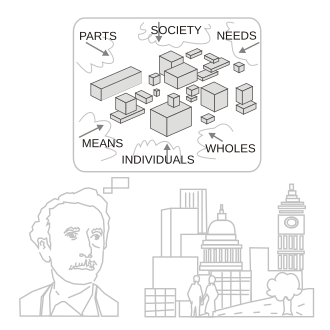
Systems thinking is a way of making sense of the complexity of the world by looking at it in terms of wholes and relationships rather than by splitting it down into its parts. It has been used as a way of exploring and developing effective action in complex contexts, enabling systems change. Systems thinking draws on and contributes to conceptual systems, systems theory, and the system sciences.
"Systems thinking is relatively recent, at least as an identifiable practice. There are books on the subject, but different authors view the subject differently, so it is an as-yet unconstrained discipline."
Systems thinking"Systems thinking means the ability to see the synergy of the whole rather than just the separate elements of a system and to learn to reinforce or change whole system patterns. Many people have been trained to solve problems by breaking a complex system, such as an organization, into discrete parts and working to make each part perform as well as possible. However, the success of each piece does not add up to the success of the whole. to the success of the whole. In fact, sometimes changing one part to make it better actually makes the whole system function less effectively."
Systems thinking"In a previous paper on progress in general systems research... I avoided the issue of defining a system. I noted that no definitions are satisfactory, and it seemed to me the essence of the subject area that none can be so. I went on to say that it is the systems approach—emphasizing lack of disciplinary boundaries, the freedom to apply knowledge, and techniques gathered in one field to problems in another, or to suggest that two distinct fields are in fact one, the disciplined freedom of the unconstrained intellect—that has been the source of dynamism and progress. I noted that perhaps the most telling progress of all is that we can so confidently speak of a common field of interest knowing that we could not, and would not wish to, agree on a definition of what a system is."
Systems thinking"Systems thinking is a mental discipline and framework for seeing patterns and interrelationships. It is important to see organizational systems as a whole because of their complexity. Complexity can overwhelm managers, undermining confidence. When leaders can see the structures that underlie complex situations, they can facilitate improvement. But doing that requires a focus on the big picture."
Systems thinking"Systems thinking is not new; it has been around for thousands of years in many different guises. Ancient creation myths were instances of systems thinking. Operations analysis, systems analysis, failure analysis, risk analysis, corporate benefit analysis, financial modeling, quantity surveying, investment appraisal, finite element analysis, civil engineering models, economic modeling, simulations, and many more are all modern ways of thinking about systems. Imaginative visualization should be on the list, too. What is new, perhaps, is the ready availability of powerful desktop tools that permit and enable us to think about the most complex and complicated issues and systems. Processors allow us to tackle problems of such complexity and magnitude that, without them, we would be obliged to guess. The same tools reveal unexpected complex behavior from simple systems."
Systems thinking"In the selection of papers for this volume, two problems have arisen, namely what constitutes systems thinking and what systems thinking is relevant to the thinking required for organizational management. The first problem is obviously critical. Unless there were a meaningful answer there would be no sense in producing a volume of readings in systems thinking in any subject. A great many writers have manifestly believed that there is a way of considering phenomena which is sufficiently different from the well-established modes of scientific analysis to deserve the particular title of systems thinking."
Systems thinking"If Critical Systems Thinking is to contribute to enlightened societal practice, e.g., with respect to the pressing environmental and social issues of our time, it should be accessible not only to well-trained decision makers and academics but also to a majority of citizens."
Systems thinking"The modern systems view, which flowered during World War II (though building on principles in the wind much earlier), has already borne its first fruits and is in danger of a superficial acceptance into the corpus of sociology by way of the incorporation of some of its now common vocabulary."
Systems thinking"An example from soft systems thinking is Checklands appreciation of soft systems methodology. He wants to introduce hard systems approaches to deal with hard problems only after and through a soft systems analysis."
Systems thinking"Systems thinking is a lost art with a very practical set of tools which our consultants and l use. lt assists us and our clients thinking, diagnoses, and actions in whatever we do... and wherever we go in a much better, more holistic and practical way than traditional methods."
Systems thinking"It was appropriate to say up front that systems thinking is the parent of design thinking and systems inquiry embeds design inquiry."
Systems thinking"Systems Thinking is based on 50+ years of scientific research by the Society for General Systems Research on the 12 Characteristics of life on earth, leading to the natural way the world works."
Systems thinking