Quote
"What shall I do? The people are impatient. Chase has no money and tells me he can raise no more. The General of the Army, McClellan, has typhoid fever. The bottom is out of the tub. What shall I do?"
 The Civil War (documentary)
The Civil War (documentary)
The Civil War (documentary)
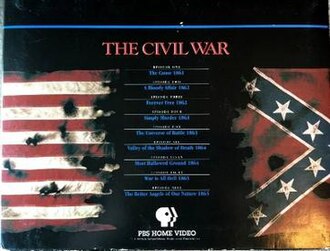
The Civil War is a 1990 American television documentary miniseries created by Ken Burns about the American Civil War. It was the first broadcast to air on PBS for five consecutive nights, from September 23 to 27, 1990.
"What shall I do? The people are impatient. Chase has no money and tells me he can raise no more. The General of the Army, McClellan, has typhoid fever. The bottom is out of the tub. What shall I do?"
The Civil War (documentary)"In the midst of all his troubles, the President delighted in his sons. The oldest, Robert, was away at Harvard, but Willie, 11, and eight-year-old Thomas, known as Tad, had the run of the White House. Willie was studious, liked to compose verse and memorize railroad timetables. He had raised a boys’ battalion from among his schoolmates and invaded Cabinet meetings with his "troops." In February, he developed what the doctor called bilious fever. His parents sat up night after night to nurse him. On February 20, Willie died. For three months, Mary Lincoln veered between loud weeping and silent depression and sought to communicate with her dead child through spiritualists."
The Civil War (documentary)"News stories described him coolly smoking under fire, and admirers shipped him barrels of cigars. A delighted Northern public now thought they knew what the initials in his name stood for: they called him "Unconditional Surrender Grant."
The Civil War (documentary)"It was suicide. They came forward, one man said, as though they were breasting a storm of rain and sleet. Faces and bodies half turned to the storm, shoulders shrugged. The Irish Brigade got within twenty-five paces of the wall. The men of the 24th Georgia who shot them down were Irish too."
The Civil War (documentary)"General Longstreet, I think, had a good reason to worry about attacking the Union position at Gettysburg. After all it was his corps at Fredericksburg that mowed down the Union troops in front of the stonewall. He could realize what the rifled musket could do, held in the hands of determined troops."
The Civil War (documentary)"I wish you could hear Joshua give off a command and see him ride along the battalion on his white horse. He looked so splendidly. He told me last night that he never felt so well in his life."
The Civil War (documentary)"It was no uncommon occurrence for a man to find the surface of his pot of coffee swimming with weevils after breaking up hardtack in it. But they were easily skimmed off and left no distinctive flavor behind."
The Civil War (documentary)"In March 1863, John Mosby’s Confederate Rangers raided Fairfax Courthouse, Virginia, capturing two captains, 30 Privates, 58 horses and Brigadier General Edwin Stoughton. "For that I am sorry," Lincoln said when told of the capture, "for I can make Brigadier Generals, but I can’t make horses." General Mosby had made life miserable for Northern commanders throughout the War. No other Confederate officer was mentioned favorably as many times in Robert E. Lee’s dispatches as John Singleton Mosby."
The Civil War (documentary)"Winfield Scott, Henry Halleck, Irving McDowell. George McClellan, John Pope, George McClellan again. Ambrose Burnside, Joseph Hooker. Lincoln could not find the General he needed. He now knew that to win the war, the Southern armies had to be crushed. He had the men, but he needed a General with the will to use them."
The Civil War (documentary)"Davis may well have been the only Southerner who understood Southern Nationality, who understood what sacrifices had to be made if the Confederacy was ever going to gel as a nation. He kept saying, "I need the kind of powers that Lincoln got. I need the kind of resources that he got in the draft laws. I need to be able to suspend the writ of habeas corpus like he did." He would have said, "We can’t live by the dogmas of the quiet past any longer." He didn’t say that, but he acted that out. He said, "I have to be given the kinds—this Confederate government needs the kind of national authority—national power that the Union had in order to win." And they didn’t get it because States’ Rights helped kill the Confederacy."
The Civil War (documentary)"Who won the war? The Union Army obviously won the war, in the sense that they were the army left standing and holding their weapons when it was all over. So the soldiers who fought in the Union Army, the generals who directed it, the President who led the country during it, won the war. If were not talking just about the series of battles that finished up with the surrender at Appomattox, but talking instead about the struggle to make something higher and better out of the country, then the question gets more complicated. The slaves won the war and they lost the war. Because they won freedom, that is the removal of slavery. But they did not win freedom, as they understood freedom."
The Civil War (documentary)"They knew each other. Grant remembered Lee very well. Lee didnt quite remember Grant. That was understandable from the time that they were acquainted, back in the early days. But I think it was the sensitivity that the two men had, for each other, and for the moment. Grant not wanting to get to the point too quickly. Lee bringing him up shortly to the point of why theyre together. Lee, dressed in his last good uniform. Grant apologizing that he was rushing from the field and didnt have time to change. The scribe being unable to hold the pen steady and having it taken by another Soldier. That, from Lees point of view, awful moment, and from Grants point of view, glorious moment, and yet for the two of them, a sad and quiet moment. And Lee taking his leave, and doffing his hat from Traveler, and riding back to his troops after securing those reasonable terms. It was the beginning of the unification of the country."
The Civil War (documentary)