Quote
"There is an ethics only if there is a problem to solve."
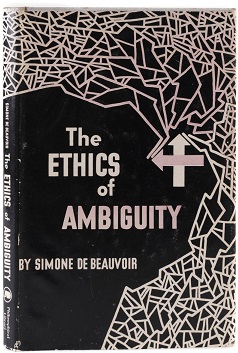 The Ethics of Ambiguity
The Ethics of Ambiguity
The Ethics of Ambiguity
The Ethics of Ambiguity is Simone de Beauvoir's second major non-fiction work. It was prompted by a lecture she gave in 1945, where she claimed that it was impossible to base an ethical system on her partner Jean-Paul Sartre's major philosophical work Being and Nothingness. The following year, over a six-month period, she took on the challenge, publishing the resulting text first as installments i
"There is an ethics only if there is a problem to solve."
The Ethics of Ambiguity"To attain his truth, man must not attempt to dispel the ambiguity of his being but, on the contrary, accept the task of realizing it."
The Ethics of Ambiguity"The characteristic feature of all ethics is to consider human life as a game that can be won or lost and to teach man the means of winning."
The Ethics of Ambiguity"Moral choice is free, and therefore unforeseeable."
The Ethics of Ambiguity"The drama of original choice is that it goes on moment by moment for an entire lifetime, that it occurs without reason, before any reason, that freedom is there as if it were present only in the form of contingency."
The Ethics of Ambiguity"Man does not create the world. He succeeds in disclosing it only through the resistance which the world opposes to him. The will is defined only by raising obstacles, and by the contingency of facticity certain obstacles let themselves be conquered, and others do not."
The Ethics of Ambiguity"What is called vitality, sensitivity, and intelligence are not ready-made qualities, but a way of casting oneself into the world and of disclosing being."
The Ethics of Ambiguity"Men do not like to feel themselves in danger. Yet, it is because there are real dangers, real failures and real earthly damnation that words like victory, wisdom, or joy have meaning. Nothing is decided in advance, and it is because man has something to lose and because he can lose that he can also win."
The Ethics of Ambiguity"Every goal is at the same time a point of departure and that human freedom is the ultimate, the unique end to which man should destine himself."
The Ethics of Ambiguity"Freedom is realized as an independence in regard to the serious world and that, on the other hand, the ambiguity of existence is felt not as a lack but in its positive aspect."
The Ethics of Ambiguity"It is the political fanaticism which empties politics of all human content and imposes the State, not for individuals, but against them."
The Ethics of Ambiguity"Far from Gods absence authorizing all license, the contrary is the case, because man is abandoned on the earth, because his acts are definitive, absolute engagements. He bears the responsibility for a world which is not the work of a strange power, but of himself, where his defeats are inscribed, and his victories as well. A God can pardon, efface, and compensate. But if God does not exist, mans faults are inexpiable."
The Ethics of Ambiguity