SHAWORDS
The Man Who Laughs

The Man Who Laughs

The Man Who Laughs

The Man Who Laughs

author
14Quotes

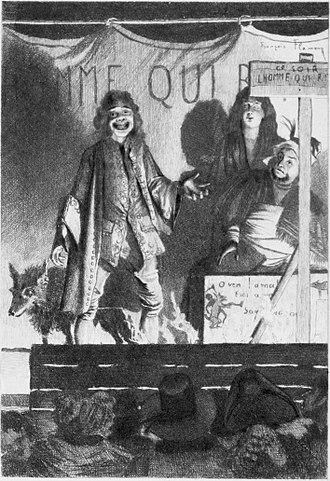
The Man Who Laughs is a Gothic novel by Victor Hugo, originally published in April 1869 under the French title L'Homme qui rit. It takes place in England beginning in 1690 and extends into the early 18th-century reign of Queen Anne. It depicts England's royalty and aristocracy of the time as cruel and power-hungry. Hugo intended parallels with the France of Louis-Philippe and the Régence.

Popular Quotes

14 total
Quote
"Fortunately Ursus had never gone into the Low Countries; there they would certainly have weighed him, to ascertain whether he was of the normal weight, above or below which a man is a sorcerer. In Holland this weight was sagely fixed by law. Nothing was simpler or more ingenious. It was a clear test. They put you in a scale, and the evidence was conclusive if you broke the equilibrium. Too heavy, you were hanged; too light, you were burned. To this day the scales in which sorcerers were weighed may be seen at Oudewater, but they are now used for weighing cheeses; how religion has degenerated!"
The Man Who LaughsThe Man Who Laughs
Quote
"Barbara, Duchess of Cleveland and Countess of Southampton, had a marmoset for a page. Frances Sutton, Baroness Dudley, eighth peeress in the bench of barons, had tea served by a baboon clad in cold brocade, which her ladyship called My Black. Catherine Sedley, Countess of Dorchester, used to go and take her seat in Parliament in a coach with armorial bearings, behind which stood, their muzzles stuck up in the air, three Cape monkeys in grand livery. A Duchess of Medina-Celi, whose toilet Cardinal Pole witnessed, had her stockings put on by an orang-outang. These monkeys raised in the scale were a counterpoise to men brutalized and bestialized."
The Man Who LaughsThe Man Who Laughs
Quote
"At intervals, that we should not become too discouraged, that we may have the stupidity to consent to bear our being, and not profit by the magnificent opportunities to hang ourselves which cords and nails afford, nature puts on an air of taking a little care of man—not to-night, though. The rogue causes the wheat to spring up, ripens the grape, gives her song to the nightingale. From time to time a ray of morning or a glass of gin, and that is what we call happiness! It is a narrow border of good round a huge winding-sheet of evil. We have a destiny of which the devil has woven the stuff and God has sewn the hem."
The Man Who LaughsThe Man Who Laughs

Similar Authors & Thinkers



