Quote
"We were the men on the front line, but the hard work of our mothers and fathers, sisters and brothers still at home made this tremendous military operation possible. We came on our feet, but we brought their hearts- and prayers- with us."
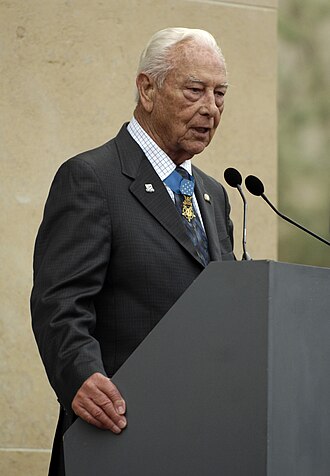
Walter D. Ehlers
Walter D. Ehlers


Walter David Ehlers was a United States Army soldier and a recipient of the US armed forces' highest decoration, the Medal of Honor, for his actions in World War II.
"We were the men on the front line, but the hard work of our mothers and fathers, sisters and brothers still at home made this tremendous military operation possible. We came on our feet, but we brought their hearts- and prayers- with us."
"Today, fifty years later, the beaches are quiet. We come back to mourn our losses, and to celebrate our success. Our presence here commemorates our and our comrades lives, and it validates the sacrifices we all made on D-Day. What was it like on D-Day? That wave in Southampton, England, was the last time I saw my brother. He died here, on Omaha Beach. That we can be here today proves that it was not in vain."
"Walter was to lead a squad unscathed up and over the sands of Omaha Beach, while Roland, known as Bud, would be killed two hours later, in the second wave of the invasion, on June 6, 1944, when a German .88 hit his landing craft. A third brother, Claus, served in the Pacific. Marie Ehlers [the Ehlers brothers mother] lived to be ninety-six."
"I was on the train, and another fellow says, Im reading here where your brother got the Medal of Honor. I said, Yes, Im reading about that, too. But I didnt tell him it was me he was reading about because I had not got the Medal yet. I got off the train, and I was headed for the CP, the Command Post, when a colonel called me by my last name. I was in fatigue uniform, and I didnt know any colonels. But this colonel knew me. He said, Sergeant Ehlers, what are you doing here? I said, Well, sir, Im reporting back to duty. He says, Well, youre supposed to be back in the States getting the Medal of Honor from President Roosevelt. And I said, Yes, sir, I read about it in Stars and Stripes. A couple of days later they had me come to a press conference, and Im just standing there. Then the general told the people that he wanted to introduce me to them and what I did in Normandy and so forth. Me? The Medal of Honor? It was quite a sensation to the press corps there to meet a Medal of Honor guy. I didnt look like anything, a young kid with a helmet, no stripes, never decorated before. Major General Clarence R. Huebner promoted me after he introduced me as having received the Medal of Honor- which I still hadnt received yet. He introduced me as Lieutenant Ehlers. After the press conference, we were coming out of there, he had his arm around my shoulder, and he said, Sergeant Ehlers, Im going to promote you to second lieutenant. I said, Well, sir, I dont think I qualify. He said, You qualify. I said, Yes, sir."
"What was it like on D-Day? That is the question most asked of veterans who were here then. We will surely all agree that it was the longest day of our lives."
"Our purpose went well beyond aiding our allies as they faced the German blitz. It was to save our way of life, for our parents and siblings at home, for our children, and the children we hoped to have, and for their children. It has been a way of life that was worth fighting for. We have enjoyed the longest period of world peace in modern history. We relish new spectrums of religious, racial, and political tolerance. We are free of the tyrannies of the likes of Hitler. We must not forget, however, what this freedom cost. We earned that security with our sweat and our blood, some of us with our lives. Much of it was earned right here in Normandy. Many of those who enjoy freedom know little of its price."

