Quote
"Success or failure in business is caused more by mental attitude even than by mental capacity."
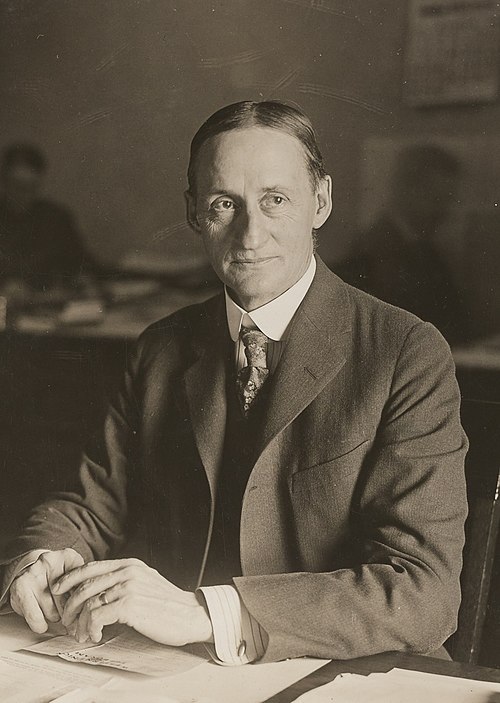 Walter Dill Scott
Walter Dill Scott
Walter Dill Scott
Walter Dill Scott was an American psychologist and academic administrator who was one of the first applied psychologists and the 10th president of Northwestern University. He applied psychology to various business practices such as personnel selection and advertising.
"Success or failure in business is caused more by mental attitude even than by mental capacity."
Walter Dill Scott"An efficient and contented employee has a positive money value to any employer. To hold him and keep him efficient, his personal comfort and needs should be considered in every way not detrimental to the companys interests."
Walter Dill Scott"The senses (the organs of sight, sound, taste, smell, temperature, and touch) are the guardians of the body, and whatever appears good to these sentinels is instantly desired, and ordinarily such things tend to the preservation and furtherance of the welfare of the body, but we choose them simply because they appear pleasing and not for ulterior ends."
Walter Dill Scott"During the last few decades the business world has brought about a complete revolution in the methods of manufacturing, distributing and selling goods. That the revolution is beneficial and important no businessman will deny. But however importantthese things? are, the business man realizes that his most pressing problem is methods of influencing and handling men rather than things:"
Walter Dill Scott"The man with the proper imagination is able to conceive of any commodity in such a way that it becomes an object of emotion to him and to those to whom he imparts his picture, and hence creates desire rather than a mere feeling of ought."
Walter Dill Scott"Advertising is a serious thing with the businessman of to-day. It is estimated that the businessmen of the United States are spending $600,000,- a year in printed forms of advertising. Furthermore one authority claims that seventy-five per cent, of all this is unprofitable. Every business man is anxious that no part of these unprofitable advertisements shall fall to his lot. The enormity of the expense, the keenness of competition, and the great liability of failure has awakened the advertising world to the pressing need for some basis of assurance in its hazardous undertakings."
Walter Dill Scott"Mental attitude is more important than mental capacity"
Walter Dill Scott"Man has been called the reasoning animal but he could with greater truthfulness be called the creature of suggestion. He is reasonable, but he is to a greater extent suggestible."
Walter Dill Scott"Some time ago a tailor in Chicago was conducting a vigorous advertising campaign. I did not suppose that his advertising was having any influence upon me. Some months after the advertising had begun I went into the tailors shop and ordered a suit. While in the shop I happened to fall into conversation with the proprietor and he asked me if a friend had recommended him to me. I replied that such was the case. Thereupon I tried to recall who the friend was and finally came to the conclusion that this shop had never been recommended to me at all. I had seen his advertisements for months and from them had formed an idea of the shop. Later, I forgot where I had received my information and assumed that I had received it from a friend who patronized the shop. I discovered that all I knew of the shop I had learned from advertisements and I doubt very much whether I ever read any of the advertisements further than the display type. Doubtless many other customers would have given the same reply even though, as in my case, no friend had spoken to them concerning the shop."
Walter Dill Scott"Goods offered as means of gaining social prestige make their appeals to one of the most profound of the human instincts. In monarchies this instinct is regarded as a mere tendency to imitate royalty. In America, with no such excuse, the eagerness with which we attempt to secure merchandise used by the "swell and swagger" is absurd, but it makes it possible for the advertiser to secure more responses than might otherwise be possible.. As an illustration of this fact we need but to look at the successful advertisements of clothing, automobiles, etc. The quality of the goods themselves does not seem to be so important as the apparent prestige given by the possession of the goods."
Walter Dill Scott"One young lady asserted that she had never looked at any of the cards in the cars in which she had been riding for years. When questioned further, it appeared that she knew by heart almost every advertisement appearing on the line (Chicago and Evanston line), and that the goods advertised had won her highest esteem. She was not aware of the fact that she had been studying the advertisements, and flatly resented the suggestion that she had been influenced by them. Some of the goods advertised were known to her only by these advertisements, yet she supposed that they had nothing to do with her esteem of the goods. She supposed that she had always known them, that they were used in her home, or that they had been recommended to her. She did not remember when she had first heard of them."
Walter Dill Scott"The selecting of men is one of the important functions in business and yet one that has not received much scientific attention. I feel sure that the time is ripe for action for two reasons. The psychologists have during the past few years made distinct advance in Mental Tests. My proposal is this: You get from your Class A members data as to their methods of selecting men. Any statements as to actual experience and as to principles or methods will be very valuable. I would make a study of these data and would have some of the men from our School of Commerce go over them with me. We would try to criticize them constructively. Perhaps we could make some suggestions that would be worth while. We would try to indicate the good points used and thus be of assistance to all members of the organization."
Walter Dill Scott




