Quote
"The real mission of machinery is to reduce pounds to shillings and shillings to pence."
W
William BurgesWilliam Burges
William Burges
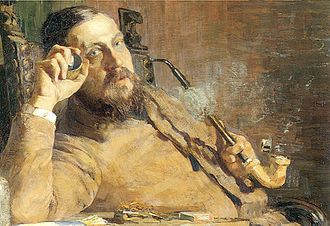
William Burges was an English architect and designer. Among the greatest of the Victorian art-architects, he sought in his work to escape from both nineteenth-century industrialisation and the Neoclassical architectural style and re-establish the architectural and social values of a utopian medieval England. Burges stands within the tradition of the Gothic Revival, his works echoing those of the P
"The real mission of machinery is to reduce pounds to shillings and shillings to pence."
"Pugin says in one of his works that had he a cathedral to build, one of the first things he would do would be to set up a to turn the smaller columns."
"The thirteenth century, in particular, was Burges’s chosen field, and he modelled his style of draughtsmanship on the famous sketchbook of in the Bibliothèque Nationale, Paris."
"If we copy, the thing never looks right [and] the same occurs with regard to those buildings which do not profess to be copies; both they and the copies want spirit. They are dead bodies... We are at our wits."
"I have been brought up in the 13th century belief, and in that belief I intend to die."
"What I set myself to do was this, to write a sort of grammar of thirteenth-century architecture, and to illustrate it with carefully measured details. I moreover resolved, when I did measure details or buildings, to do the part I wanted, and not to waste time by trying to make a finished drawing by means of the surroundings. The plan of the book fell through, for I had scarcely been at work two months before the advertisement of M. Viollet-le-Ducs Dictionary appeared, and I then continued tho drawings for my own instruction and without any intention of publication."
"We have no architecture to work from at all; indeed, we have not even settled the point de depart... our art... is domestic, and... the best way of advancing its progress is to do our best in our own houses... if we once manage to obtain a large amount of art and colour in our sitting-rooms... the improvement may gradually extend to our costume, and perhaps eventually to the architecture of our houses."
"Use a good strong thick bold line so that we may get into the habit of leaving out those prettinesses which only cost money and spoil our design."
"Great praise must also be given to the Society of Arts for beginning the movement and carrying it on to the present time; and although the sphere of its action must necessarily be infinitely smaller than that of the Government Schools, yet we should always remember that the initiative of our great English exhibitions of industry came from the Society, and that it is to those exhibitions that we owe the stirring among the dry bones of industrial art which is now taking place."
"Allowing, therefore, the great usefulness of the Government Schools, the Exhibitions, and the Museums both public and private, the question now arises as to what are the impediments to our future progress. The principal ones appear to me to be three."
"Of course there is no prima facie reason why cheap things should be ugly, for a die or mould of a good design costs no more than a bad one; but still the fact remains that the objects in use in every-day life are not beautiful, and it is to effect a change in this respect that the Government have established Schools of Design and the excellent Museum of which I shall have to speak hereafter."
"Since the great French Revolution all colour has been gradually dying out of the male costume, until we have got reduced to our present gamut of brown, black and neutral tint; which, combined with the chimney-pot hat and the swallow-tailed coat, form a costume by no means particularly adapted to refresh the eye seeking for form or colour."