SHAWORDS
William D. Leahy

William D. Leahy

William D. Leahy

William D. Leahy

author
28Quotes

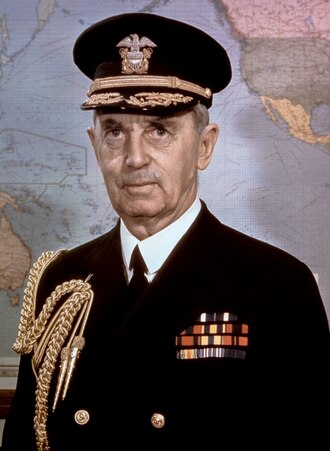
William Daniel Leahy was an American naval officer and was the most senior United States military officer on active duty during World War II; he held several titles and exercised considerable influence over foreign and military policy. As a fleet admiral, he was the first flag officer ever to hold a five-star rank in the U.S. Armed Forces.

Popular Quotes

28 total
Quote
"Throughout the war, the four of us- Marshall, King, Arnold, and myself- worked in the closest possible harmony. In the postwar period, General Marshall and I disagreed sharply on some aspects of our foreign political policy. However, as a soldier, he was in my opinion one of the best, and his drive, courage, and imagination transformed Americas citizen army into the most magnificent fighting force ever assembled. In number of men and logistical requirements, his army operations were by far the largest. This meant that more time of the Joint Chiefs were spent on his problems than on any others- and he invariably presented them with skill and clarity. King had an equally difficult task. His fleets had to hold Japan at bay while convoying millions of tons of supplies for the second front. He was an exceptionally able sea commander. He was also explosive and there were times when it was just as well that the deliberations of the Joint Chiefs were a well-kept secret. The President had a high opinion of Kings ability but he was a very undiplomatic person, especially when the Admirals low boiling point would be reached in some altercation with the British. King would have preferred to put more power into the Asiatic war earlier. He supported loyally the general strategy of beating Germany first, but this often required concessions of ships which he did not like to make. He could not spare much, since, until the last months of the war, he was working with a deficit of ships. America was fighting a two-ocean war for the first time in its history."
William D. LeahyWilliam D. Leahy
Quote
"To King, Leahy, Nimitz, and naval officers in general, it had always seemed that the defeat of Japan could be accomplished by sea and air power alone, without the necessity of actual invasion of the Japanese home islands by ground troops. In 1942, 1943, and 1944, while the attention of most of the Allied political and military leaders was concentrated on Europe, and while the war against Japan was left largely to King to manage with what forces he could muster, the Pacific war had proceeded largely upon this assumption. With the approaching victory in Europe a larger amount of attention was concentrated on the Pacific by people who had not previously been too greatly concerned with the problems of that war, and an increasing amount of high-priced thought was devoted to it, some of which seemed to King not strictly pertinent. From the time of the Teheran Conference there had been the political consideration of Soviet intervention in the war against Japan, and the Army had been convinced that the use of ground troops would be necessary. Upon Marshalls insistence, which also reflected MacArthurs views, the Joint Chiefs had prepared plans for landings in Kyushu and eventually in the Tokyo plain. King and Leahy did not like the idea, but as unanimous decisions were necessary in the Joint Chiefs meetings, they reluctantly acquiesced, feeling that in the end sea power would accomplish the defeat of Japan, as proved to be the case."
William D. LeahyWilliam D. Leahy
Quote
"Above all these sailors was the Commander in Chief, Franklin D. Roosevelt- a remarkable leader indeed. Unlike Winston Churchill, Roosevelt never imagined himself to be a strategist. In general he followed the advice of the Joint Chiefs of Staff, which included King, Marshall, and his own chief of staff, wise old Admiral Leahy. Thrice at least he went over their heads- refusing to redeploy American forces into the Pacific in 1942, insisting that Guadalcanal must be reinforced and held at all costs, and inviting a British fleet to participate in the Okinawa campaign. He also threw his influence in favor of MacArthurs desire to liberate Leyte and Luzon against the Navys wish to bypass them. He was a tower of strength to Marshall, King and Eisenhower against insistent British pressure to postpone OVERLORD and shift DRAGOON from Marseilles to Trieste. The Navy was his favorite service- I heard him once, in his true regal style refer to it as "my Navy"- and he did his utmost to build it up and improve its efficiency both before and during the war."
William D. LeahyWilliam D. Leahy
Quote
"During the closing days of 1944 King received the final promotion of his naval career. On 11 December the Congress passed a bill authorizing the appointment of four Fleet Admirals and four Generals of the Army. The President immediately named Leahy, King and Nimitz to the naval five-star rank (Halsey later became the fourth.), and Marshall, MacArthur, Eisenhower and Arnold to the corresponding grade in the Army. The Senate confirmed these appointments on 15 December 1944, and on 20 December- the third anniversary of his designation as Commander in Chief, United States Fleet- King took the oath of office as a Fleet Admiral in the United States Navy."
William D. LeahyWilliam D. Leahy
Quote
"Historians have concluded that Truman grew into the role of commander in chief, and eventually proved more than equal to the job. But in the spring and summer of 1945, the growing pains were evident- and the decisions he must confront during those early weeks were among the most important of his presidency. In his diary, Bill Leahy expressed concern about the "staggering burdens of war and peace that [Truman] must carry." Privately, according to Leahys son, the admiral regarded his new boss as a "bush-leaguer." He had been accustomed to speaking his mind to Roosevelt, knowing that the late president was "captain of the team" and might accept or reject his advice according to his own judgment. But Truman did not yet possess the confidence or independence to buck his advisers. Truman was in their hands, Leahy told another aide, which meant everyone who advised the president bore heavy responsibility, and must be absolutely sure they were right. In his diary and his subsequent memoir, Leahy betrayed no sense of responsibility or culpability for the new presidents relative ignorance. One is struck by this lack of self-awareness in a Washington statesman otherwise respected for his wisdom and good judgment. Whatever he knew or did not know about the state of FDRs declining health, Leahy had been at the late presidents elbow for most of the last year of his life. He certainly knew enough to anticipate that Truman might be thrust into the role of commander in chief at any moment. Leahy was the White House chief of staff and the chairman of the JCS. What steps did he take to ensure that the vice president was properly briefed? Who else had that duty, if not himself? No adequate explanation has ever been provided for this breakdown in the basic procedures of sound constitutional government."
William D. LeahyWilliam D. Leahy
Quote
"Leahy had been personally close to FDR, he told Truman, and was "distressed" by his death. He was inclined to retire from the navy and from his position as White House chief of staff. But Truman needed him for the sake of continuity, if nothing else, and asked him to stay on the job to help him "pick up the strands of the business of war." After Truman gave assurances that he would adhere to the same decision-making procedures used by FDR, Leahy agreed to remain on the job for at least a few more months. It turned out that he served another four years, to the end of Trumans first term in office."
William D. LeahyWilliam D. Leahy
Quote
"Dear Admiral: I am writing this on the train going 90 mi. an hour. I hope you will be able to read it. I received your letter enclosing an article by Constantine Brown. I wish I could get my hands on him and on the fellow who gave him the false information in the first place. I want you in the White House. I have the utmost confidence in you. You tell me what you think. While you and I dont see eye to eye on some things, we are always frank with each other. Dont you pay any attention to any lying stories the gossipers write. Its part of the political farce as its played in this country. The opposition try to hurt me by hurting my friends. Please dont let it bother you. When I have anything to say to you, Ill say it to you. You are my friend and I am yours come hell or high water. Sincerely, Harry S. Truman"
William D. LeahyWilliam D. Leahy
Quote
"Once it had been tested, President Truman faced the decision as to whether to use it. He did not like the idea, but was persuaded that it would shorten the war against Japan and save American lives. It is my opinion that the use of this barbarous weapon at Hiroshima and Nakasaki was of no material assistance in our war against Japan. The Japanese were already defeated and ready to surrender because of the effective sea blockade and the successful bombing with conventional weapons. It was my reaction that the scientists and others wanted to make this test because of the vast sums that had been spent on the project. Truman knew that, and so did the other people involved. However, the Chief Executive made a decision to use the bomb on two cities in Japan. We had produced only two bombs at that time. We did not know which cities would be the targets, but the President specified that the bombs should be used against military facilities. I realized that my original error in discounting the effectiveness of the atomic bomb was based on long experience with explosives in the Navy. I had specialized in gunnery and at one time headed the Navy Departments Bureau of Ordnance. "Bomb" is the wrong word to use for this new weapon. It is not a bomb. It is a poisonous thing that kills people by its deadly radioactive action, more than by the explosive force it develops."
William D. LeahyWilliam D. Leahy
Quote
"The lethal possibilities of atomic warfare in the future are frightening. My own feeling was that in being the first to use it, we had adopted an ethical standard common to the barbarians of the Dark Ages. I was not taught to make war in that fashion, and wars cannot be won by destroying women and children. We were the first to have this weapon in our possession, and the first to use it. There is a practical reality that potential enemies will have it in the future and that atomic bombs will sometime be used against us. That is why, as a professional military man with a half-century of service to his government, I come to the end of my war story with an apprehension about the future. These new concepts of "total war" are basically distasteful to the soldier and sailor of my generation. Employment of the atomic bomb in war will take us back in cruelty toward non-combatants to the days of Genghis Khan. It will be a war of pillage and rape of a society, done impersonally by one state against another, whereas in the Dark Ages it was a result of individual greed and terrorism. Thee new and terrible instruments of uncivilized warfare represent a modern type of barbarism not worthy of Christian man. One of the professors associated with the Manhattan Project told me that he had hoped the bomb wouldnt work. I wish that he had been right."
William D. LeahyWilliam D. Leahy
Quote
"[MacArthurs "Old Soldiers Never Die" speech was of] such a superlative quality of excellence... that there is no other individual... capable of preparing and delivering a comparable address... The public enthusiasm for General MacArthur in San Francisco and in Washington was a triumph beyond anything that I have ever seen anywhere for anybody, which seems strange in view of his recent summary detachment by President Truman. If the generals popularity persists for a considerable time, it should actively effect a change in the countrys domestic political policy, and it might have a radical effect on the complexion of domestic political development. From a purely military point of view it appears that General MacArthurs attitude will be fully accepted by all qualified military authorities."
William D. LeahyWilliam D. Leahy

Similar Authors & Thinkers



