SHAWORDS
Ya'qub ibn al-Layth al-Saffar

Ya'qub ibn al-Layth al-Saffar

Ya'qub ibn al-Layth al-Saffar

author
2Quotes

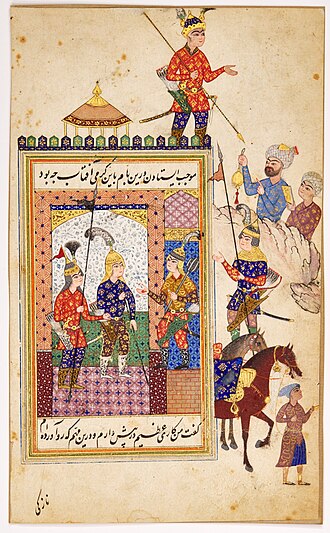
Ya'qub ibn al-Layth Saffar was a coppersmith and the founder of the Saffarid dynasty of Sistan, with its capital at Zarang. Under his military leadership, he conquered much of the eastern portions of Greater Iran consisting of modern-day Iran, Afghanistan, Turkmenistan, Uzbekistan, Tajikistan as well as portions of western Pakistan and a small part of Iraq. He was succeeded by his brother, Amr ibn

Popular Quotes

2 total
Quote
"After this we read nothing of Kabul till the time of the Saffarides — A.H. 256 A.D. 868-9. In the succeeding year Yakiib Lais took Kabul, and made its prince a prisoner. The king of Ar Rukhaj was put to death, and its inhabitants forced to embrace Islam. Yakiib returned to his capital loaded with booty, and carrying with him the heads of three kings ; and many statues of Indian divinities, which were amongst the booty, were sent to Baghdad for presentation to the Khalif."
Ya'qub ibn al-Layth al-SaffarYa'qub ibn al-Layth al-Saffar
Quote
"“He first took Bãmiãn, which he probably reached by way of Herãt, and then marched on Balkh where he ruined (the temple) Naushãd. On his way back from Balkh he attacked Kãbul… “Starting from Panjhîr, the place he is known to have visited, he must have passed through the capital city of the Hindu Šãhîs to rob the sacred temple - the reputed place of coronation of the Šãhî rulers-of its sculptural wealth… “The exact details of the spoil collected from the Kãbul valley are lacking. The Tãrîkh [-i-Sistãn] records 50 idols of gold and silver and Mas’udî mentions elephants. The wonder excited in Baghdãd by elephants and pagan idols forwarded to the Caliph by Ya’qûb also speaks for their high value. “The best of our authorities put the date of this event in 257 (870-71). Tabarî is more precise and says that the idols sent by Ya’qûb reached Baghdãd in Rabî’ al-Ãkhar, 257 (Feb.-March, 871). Thus the date of the actual invasion may be placed at the end of AD 870.”"
Ya'qub ibn al-Layth al-SaffarYa'qub ibn al-Layth al-Saffar

Similar Authors & Thinkers