SHAWORDS

A more modern attempt to explain the fruitfulness of mathematical reas — Mathematical induction

"A more modern attempt to explain the fruitfulness of mathematical reasoning is that of Poincaré, who finds it all due to the principle of mathematical induction. This principle of mathematical induction is undoubtedly of wide application, though there are many regions even in arithmetic where it is difficult to see its application, e.g., the science of prime numbers, a science dealing entirely with non-recurring individuals. But the important thing to observe is that this principle of mathematical induction is entirely different from the induction that prevails in the physical sciences."
Mathematical induction
author12 quotes

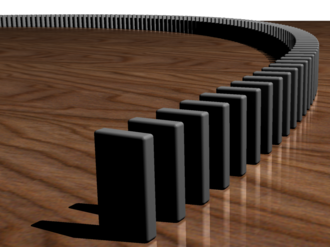
Mathematical induction is a method for proving that a statement is true for every natural number , that is, that the infinitely many cases   all hold. This is done by first proving a simple case, then also showing that if we assume the claim is true for a given case, then the next case is also true. Informal metaphors help to explain this technique, such as falling dominoes or climbing a ladder:M

More by Mathematical induction

View all →
Quote
"The propositions of arithmetic, the... operations, for instance, which play such a fundamental rôle even in the most simple calculations, must be demonstrated by deductive methods. What is the principle involved? Well, this principle has been variously called mathematical induction, and complete induction, and that of reasoning by recurrence. The latter is the only acceptable name, the others being misnomers. The term induction conveys an entirely erroneous idea of the method, for it does not imply systematic trials."
Mathematical inductionMathematical induction
Quote
"M. Poincaré finds the answer to these questions in the so-called mathematical induction which proceeds from the particular to the more general, but at the same time does so by steps of the highest degree of certitude. In this process he sees the creative force of mathematics, which leads to real proofs and not mere sterile verifications. The illustrations used to make the thought clear are taken from the beginnings of arithmetic, where mathematical thought has remained least elaborated and uncomplicated by the difficult questions related to the notion of space. In successive instances it is shown how more general results are obtained from fundamental definitions and from previous results by means of mathematical induction. In each case the advance is made by virtue of that "power of the mind which knows that it can conceive of the indefinite repetition of the same act as soon as this act is at all possible. The mind has a direct intuition of this power and experience gives only the opportunity to use it and to become conscious of it." The conviction that the method of mathematical induction is valid our author regards as truly an à priori synthetic judgment; the mind can not tolerate nor conceive its contradictory and could not even draw any theoretic consequences from the assumption of the contradictory. No arithmetic could be built up, rejecting the axiom of mathematical induction, as the non-Euclidean geometries have been built up, rejecting the postulate of Euclid."
Mathematical inductionMathematical induction
Quote
"It is absolutely certain that if a proposition is established by mathematical induction, it will never be disproved, i.e., if a general proposition is true of n + 1 whenever it is true of n, and also of 1, then no possible number can arise of which this proposition is not true, for the principle of mathematical induction is used in defining all finite integers. Whether, therefore, we agree with Russell and call the principle of mathematical induction a definition, or concede to Poincaré that it is a special axiom, a synthetic proposition a priori, the fact remains that reasoning from it is a purely deductive procedure."
Mathematical inductionMathematical induction
Quote
"One who extended the theory of equations somewhat further than Vieta was Albert Girard... Like Vieta this ingenious author applied algebra to geometry, and was the first who understood the use of negative roots in the solution of geometric problems. He spoke of imaginary quantities; inferred by induction that every equation has as many roots as there are units in the number expressing its degree; and first showed how to express the sums of their powers in terms of the coefficients."
Mathematical inductionMathematical induction