Quote
"This letter, if judged by the novelty and profundity of ideas it contains, is perhaps the most substantial piece of writing in the whole literature of mankind."
H
Hermann Weyl"A new development began for relativity theory after 1925 with its absorption into quantum physics. The first great success was scored by Diracs quantum mechanical equations of the electron, which introduced a new sort of quantities, the spinors, besides the vectors and tensors into our physical theories. ...But difficulties of the gravest kind turned up when one passed from one electron or photon to the interaction among an indeterminate number of such particles. In spite of several advances a final solution of this problem is not yet in sight and may well require a deep modification of the foundation of quantum mechanics, such as would account in the same basic manner for the elementary electric charge e as relativity theory and our present quantum mechanics account for c and h."
Hermann Klaus Hugo Weyl was a German mathematician, theoretical physicist, logician and philosopher. Although much of his working life was spent in Zürich, Switzerland, and then Princeton, New Jersey, he is associated with the University of Göttingen tradition of mathematics, represented by Carl Friedrich Gauss, David Hilbert and Hermann Minkowski.
"This letter, if judged by the novelty and profundity of ideas it contains, is perhaps the most substantial piece of writing in the whole literature of mankind."
"Consciousness spreads out its web, in the form of time, over reality."
"In the realm of physics it is perhaps only the theory of relativity which has made it quite clear that the two essences, space and time, entering into our intuition, have no place in the world constructed by mathematical physics. Colours are thus "really" not even æther-vibrations, but merely a series of values of mathematical functions in which occur four independent parameters corresponding to the three dimensions of space, and the one of time."
"It seems clear that [set theory] violates against the essence of the continuum, which, by its very nature, cannot at all be battered into a single set of elements. Not the relationship of an element to a set, but of a part to a whole ought to be taken as a basis for the analysis of a continuum."
"We now come to a decisive step of mathematical abstraction: we forget about what the symbols stand for... [The mathematician] need not be idle; there are many operations which he may carry out with these symbols, without ever having to look at the things they stand for."
"Hermann Weyl was both a mathematician and a mathematical physicist. Weyl wrote on mathematics, general relativity... quantum mechanics... art and philosophy. His smaller book on philosophy is entitled The Open World. It is made up of lectures... in 1932 at Yale University. In the philosophy of science, according to Weyl, complexity is essential in understanding the concept of a law of nature. If laws of nature may be arbitrarily complex, he argued, the very concept... becomes vacuous. What difference would remain... if the laws meant to explain them were as complex as the phenomena they are meant to explain? Laws of nature must be simple."
"In the life of the mass-order, the culture of the generality tends to conform to the demands of the average human being. Spirituality decays through being diffused among the masses when knowledge is impoverished in every possible way by rationalisation until it becomes accessible to the crude understanding of all."
"I say this to you because we Spaniards are a forgetful people, because we are used to living for the moment, because we do not look back, because we do not know how to see the chain of heroes, because we do not contemplate the sum of sacrifices."
 Francisco Franco
"Sharon Tate was my best friend. Once, we were roommates. She introduced me to my husband. She was the godmother to my baby daughter who is named for her. In the six years time that I knew her, she never said an unkind word about anyone."
"Long time to see. (VS: Tapion)"
"Most mathematicians prove what they can, von Neumann proves what he wants." Once in a discussion about the rapid growth of mathematics in modern times, von Neumann was heard to remark that whereas thirty years ago a mathematician could grasp all of mathematics, that is impossible today. Someone asked him: "What percentage of all mathematics might a person aspire to understand today?" Von Neumann went into one of his five-second thinking trances, and said: "About 28 percent."
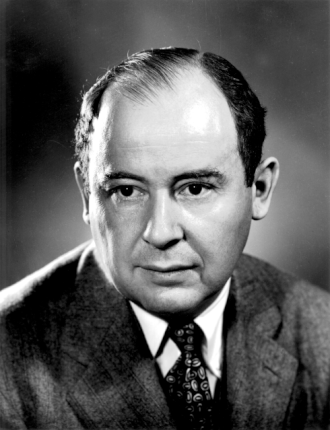 John von Neumann
"Children must be free to think in all directions irrespective of the peculiar ideas of parents who often seal their childrens minds with preconceived prejudices and false concepts of past generations. Unless we are very careful, very careful indeed, and very conscientious, there is still great danger that our children may turn out to be the same kind of people we are."