SHAWORDS

A poem does invite, it does require. What does it invite? A poem invit — Muriel Rukeyser

"A poem does invite, it does require. What does it invite? A poem invites you to feel. More than that: it invites you to respond. And better than that: a poem invites a total response. This response is total, but it is reached through the emotions. A fine poem will seize your imagination intellectually — that is, when you reach it, you will reach it intellectually too — but the way is through emotion, through what we call feeling."
Muriel Rukeyser
Muriel Rukeyser
Muriel Rukeyser
author30 quotes

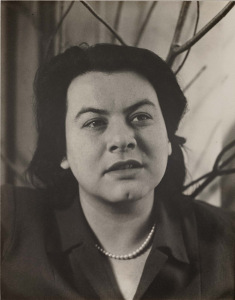
Muriel Rukeyser was an American poet, essayist, biographer, novelist, screenwriter, and political activist. She wrote across genres and forms, addressing issues related to racial, gender, and class justice, war and war crimes, Jewish culture and diaspora, and American history, politics, and culture. Kenneth Rexroth said that she was the greatest poet of her "exact generation." Anne Sexton famously

More by Muriel Rukeyser

View all →
Quote
"In time of the crises of the spirit, we are aware of all of need, our need for each other and our need for ourselves. We call up our fullness; we turn, and act. We begin to be aware of correspondences, of the acknowledgement in us of necessity, and of the lands. And poetry, among all this — where is there a place for poetry? If poetry as it comes to us through action were all we had, it would be very much. For the dense and crucial moments, spoken under the stress of realization, full-bodied and compelling in their imagery, arrive with music, with our many kinds of theatre, and in the great prose. If we had these only, we would be open to the same influences, however diluted and applied. For these ways in which poetry reaches past the barriers set up by our culture, reaching toward those who refuse it in essential presence, are various, many-meaning, and certainly — in this period — more acceptable. They stand in the same relation to poetry as applied science to pure science."
Muriel RukeyserMuriel Rukeyser
Quote
"The creation of a poem, or mathematical creation, involves so much sense of arrival, so much selection, so much of the desire that makes choice — even though one or more of these may operate in the unconscious or partly conscious work-periods before the actual work is achieved — that the questions raised are very pertinent. . . . The poet chooses and selects and has that sense of arrival as the poem ends; he is expressing what it feels like to arrive at his meanings. If he has expressed that well, his reader will arrive at his meanings. The degree of appropriateness of expression depends on the preparing. By preparing I mean allowing the reader to feel the interdependences, the relations, within the poem. These inter-dependences may be proved, if you will allow the term, in one or more ways: the music by which the syllables resolve may lead to a new theme, as in a verbal music, or to a climax, a key-relationship which makes — for the moment — an equilibrium; the images may have established their own progression in such a way that they serve to mark the poem’s development; the tensions and attractions between the poem’s meanings may mark its growth, as they must if the poem is to achieve its form. A poem is an imaginary work, living in time, indicated in language. It is and it expresses; it allows us to express."
Muriel RukeyserMuriel Rukeyser
Quote
"The continuity of film, in which the writer deals with a track of images moving at a given rate of speed, and a separate sound-track which is joined arbitrarily to the image-track, is closer to the continuity of poetry than anything else in art. But the heaviness of the collective work on a commercial film, the repressive codes and sanctions, unspoken and spoken, the company-town feeling raised to its highest, richest, most obsessive-compulsive level in Hollywood, puts the process at the end of any creative spectrum farthest from the making of a poem. At the same time, almost anything that can be said to make the difficulties of poetry dissolve for the reader, or even to make the reader want to deal with those "difficulties," can be said in terms of film. These images are like the action sequences of a well-made movie — a good thriller will use the excitement of timing, of action let in from several approaches, of crisis prepared for emotionally and intellectually, so that you can look back and recognize the way of its arrival; or, better, feel it coming until the moment of proof arrives, meeting your memory and your recognition. The cutting of films is a parable in the motion of any art that lives in time, as well as a parable in the ethics of communication."
Muriel RukeyserMuriel Rukeyser