Quote
"What do you want — a cliff over a city? A foreland, sloped to sea and overgrown with roses? These people live here."
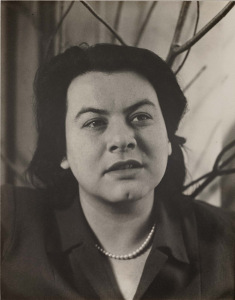 Muriel Rukeyser
Muriel Rukeyser
Muriel Rukeyser
Muriel Rukeyser was an American poet, essayist, biographer, novelist, screenwriter, and political activist. She wrote across genres and forms, addressing issues related to racial, gender, and class justice, war and war crimes, Jewish culture and diaspora, and American history, politics, and culture. Kenneth Rexroth said that she was the greatest poet of her "exact generation." Anne Sexton famously
"What do you want — a cliff over a city? A foreland, sloped to sea and overgrown with roses? These people live here."
Muriel Rukeyser"In time of crisis, we summon up our strength. Then, if we are lucky, we are able to call every resource, every forgotten image that can leap to our quickening, every memory that can make us know our power. And this luck is more than it seems to be: it depends on the long preparation of the self to be used. In time of the crises of the spirit, we are aware of all our need, our need for each other and our need for our selves. We call up, with all the strength of summoning we have, our fullness."
Muriel Rukeyser"There are ways in which poetry reaches the people who, for one reason or another, are walled off from it. Arriving in diluted forms, serving to point up an episode, to give to a climax an intensity that will carry it without adding heaviness, to travel toward the meaning of a work of graphic art, nevertheless poetry does arrive. And in the socially accepted forms, we may see the response and the fear, expressed without reserve, since they are expressed during enjoyment which has all the sanctions of society. Close to song, poetry reaches us in the music we admit: the radio songs that flood our homes, the juke-boxes, places where we drink and eat, the songs of work for certain occupations, the stage-songs we hear as ticketed audience."
Muriel Rukeyser"In this moment when we face horizons and conflicts wider than ever before, we want our resources, the ways of strength. We look again to the human wish, its faiths, the means by which the imagination leads us to surpass ourselves. If there is a feeling that something has been lost, it may be because much has not yet been used, much is still to be found and begun. Everywhere we are told that our human resources are all to be used, that our civilization itself means the uses of everything it has — the inventions, the histories, every scrap of fact. But there is one kind of knowledge — infinitely precious, time-resistant more than monuments, here to be passed between the generations in any way it may be: never to be used. And that is poetry."
Muriel Rukeyser"We are against war and the sources of war. We are for poetry and the sources of poetry. They are everyday, these sources, as the sources of peace are everyday, infinite and commonplace as a look, as each new sun."
Muriel Rukeyser"Experience taken into the body, breathed-in, so that reality is the completion of experience, and poetry is what is produced. And life is what is produced. To stand against the idea of the fallen world, a powerful and destructive idea overshadowing Western poetry. In that sense, there is no lost Eden, and God is the future. The child walled-up in our life can be given his growth. In this growth is our security."
Muriel Rukeyser"Slowly I would get to pen and paper, Make my poems for others unseen and unborn. In the day I would be reminded of those men and women, Brave, setting up signals across vast distances, considering a nameless way of living, of almost unimagined values."
Muriel Rukeyser"O for Gods sake they are connected underneath."
Muriel Rukeyser"Sisyphus is not, finally, a useful image. You dont roll some unitary boulder of language or justice uphill; you try with others to assist in cutting and laying many stones, designing a foundation. One of the stonecutter-architects I met was Muriel Rukeyser, whose work I had begun reading in depth in the 1980s. Through her prose Rukeyser had engaged me intellectually; her poetry, however, in its range and daring, held me first and last. "Her Vision" is a tribute to the mentorship of her work."
Muriel Rukeyser"A poem does invite, it does require. What does it invite? A poem invites you to feel. More than that: it invites you to respond. And better than that: a poem invites a total response. This response is total, but it is reached through the emotions. A fine poem will seize your imagination intellectually — that is, when you reach it, you will reach it intellectually too — but the way is through emotion, through what we call feeling."
Muriel Rukeyser"I speak to you. You speak to me. Is that fragile?"
Muriel Rukeyser"What would happen if one woman told the truth about her life? The world would split open."
Muriel Rukeyser




