Quote
"Those who try to give us advice on matters of human rights do nothing but provoke an ironic smile among us. We will not permit anyone to interfere in our affairs."
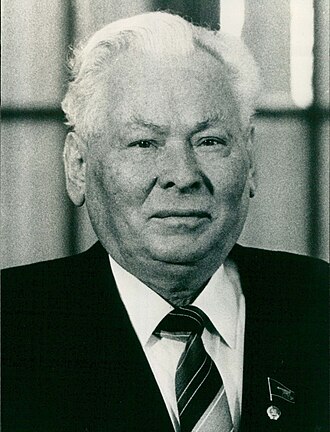 Konstantin Chernenko
"A staleness was particularly apparent in the early 1980s, and notably under Chernenko, who died on 10 March 1985. An impression of stagnation, if not decay, became more insistent and was commented on both within and outside the Soviet Union. ‘The patient had died already on the operating table’ by 1985, although few of the top Soviet leaders understood that. Yet, underlying later counterfactuals about whether different outcomes were possible, very few commentators proved willing to predict that the Soviet bloc would soon collapse. There was an awareness in the West of its economic problems, but not of their consequences. The ability to suppress dissent in Poland in 1981 encouraged a sense that force would help deal with problems. However, the combination of Soviet economic difficulties, Soviet political sluggishness, and a much broader and better educated Soviet citizenry, indicated that the country in 1985 was very different to what had been called for and anticipated during the 1917 Revolution. Moreover, the citizenry was aware of this contrast."
Konstantin Ustinovich Chernenko was a Soviet politician who served as the de jure leader of the Soviet Union from February 1984 until his death in March 1985.
"Those who try to give us advice on matters of human rights do nothing but provoke an ironic smile among us. We will not permit anyone to interfere in our affairs."
Konstantin Chernenko"All this is forcing the USSR to fortify the nations defences. The Soviet people want no arms build-up. What they want is arms reduction on both sides. But we are compelled to see to our countrys essential security and also to that of our friends and allies. That is exactly what is being done. And we want everybody to remember that no adventure-seekers will ever succeed in catching us unawares, that no potential aggressor has the slightest chance of escaping a devastating retaliatory strike."
Konstantin Chernenko"As a great socialist power the Soviet Union is fully aware of its responsibility to the peoples for preserving and strengthening peace. We are open to peaceful, mutually beneficial cooperation with states on all continents. We are for the peaceful settlement of all disputable international problems through serious, equal, and constructive talks."
Konstantin Chernenko"Washingtons adventuristic policy, whipping up international tension to the utmost, is pushing mankind towards nuclear catastrophe."
Konstantin Chernenko"The Soviet Union has long been proposing to outlaw chemical weapons, to remove them from the arsenals of states. We are prepared for resolution of this problem either on a global basis or piece by piece. As one of the first steps the USSR and the other socialist countries proposed in January 1984 that agreement be reached on ridding Europe of all types of chemical weapons."
Konstantin Chernenko"You know, comrades, that Konstantin Ustinovich has been gravely ill for a long time, and has been in the hospital in recent months. On the part of the Fourth Main Department, all necessary measures were taken in order to treat Konstantin Ustinovich. But the illness did not submit to the cure, it started to weaken his systems first slowly, and then faster and faster. It became especially aggravated as a result of pneumonia in both lungs, which Konstantin Ustinovich developed during his vacation in Kislovodsk. There were periods when we succeeded in alleviating the lung and heart insufficiencies, and during those periods Konstantin Ustinovich found enough strength to come to work. Several times he conducted Politburo sessions, and put in work days, although shortened ones. Emphysema of the lungs and the aggravated lung and heart insufficiency had worsened significantly in the last two or three weeks. Another, accompanying illness had developed—chronic hepatitis, i.e. liver failure with its transformation into cirrhosis. The cirrhosis of the liver and the worsening dystrophic changes in the organs and tissues led to the situation where not with standing intensive therapy, which was administered actively on a daily basis, the state of his health gradually deteriorated. On March 10 at 3:00 p.m., Konstantin Ustinovich lost consciousness, and at 19:20 death occurred as a result of heart failure."
Konstantin Chernenko"The smart way to keep people passive and obedient is to strictly limit the spectrum of acceptable opinion, but allow very lively debate within that spectrum - even encourage the more critical and dissident views. That gives people the sense that theres free thinking going on, while all the time the presuppositions of the system are being reinforced by the limits put on the range of the debate."
"There is no ethical idea which it [dharma] has not stressed, put in its most ideal and imperative form, enforced by teaching, injunction, parable, artistic creation, formative examples. Truth, honour, loyalty, fidelity, courage, chastity, love, long-suffering, self-sacrifice, harmlessness, forgiveness, compassion, benevolence, beneficence are its common themes, are, in its view, the very stuff of a right human life, the essence of mans dharma. Buddhism, with its high and noble ethics, Jainism, with its austere ideal of self-conquest, Hinduism, with its magnificent examples of all sides of the Dharma, are not inferior in ethical teaching and practice to any religion or system, but rather take the highest rank and have had the strongest effective force."
"Moving forward will not be for the faint of heart. But if the next century witnesses failure, let it be because our science is not yet up to the job, not because we dont have the courage to make less random the sometimes most unfair courses of human evolution."
"Our units of temporal measurement, from seconds on up to months, are so complicated, asymmetrical and disjunctive so as to make coherent mental reckoning in time all but impossible. Indeed, had some tyrannical god contrived to enslave our minds to time, to make it all but impossible for us to escape subjection to sodden routines and unpleasant surprises, he could hardly have done better than handing down our present system. It is like a set of trapezoidal building blocks, with no vertical or horizontal surfaces, like a language in which the simplest thought demands ornate constructions, useless particles and lengthy circumlocutions. Unlike the more successful patterns of language and science, which enable us to face experience boldly or at least level-headedly, our system of temporal calculation silently and persistently encourages our terror of time. ... It is as though architects had to measure length in feet, width in meters and height in ells; as though basic instruction manuals demanded a knowledge of five different languages. It is no wonder then that we often look into our own immediate past or future, last Tuesday or a week from Sunday, with feelings of helpless confusion."
"We must present democracy as a force holding within itself the seeds of unlimited progress by the human race. By our actions we should make it clear that such a democracy is a means to a better way of life, together with a better understanding among nations. Tyranny inevitably must retire before the tremendous moral strength of the gospel of freedom and self-respect for the individual, but we have to recognize that these democratic principles do not flourish on empty stomachs, and that people turn to false promises of dictators because they are hopeless and anything promises something better than the miserable existence that they endure. However, material assistance alone is not sufficient. The most important thing for the world today in my opinion is a spiritual regeneration which would reestablish a feeling of good faith among men generally. Discouraged people are in sore need of the inspiration of great principles. Such leadership can be the rallying point against intolerance, against distrust, against that fatal insecurity that leads to war. It is to be hoped that the democratic nations can provide the necessary leadership."
"James Baker was the only leader in America who had the guts to stand up and act against Israels malignant disease: the settlements. When he was the Secretary of State, he simply informed the Israeli government that he would deduct the sums expended on the settlements from the money Israel was getting from the US. Threatened and made good on his threat. Baker thus confronted the "pro-Israeli" lobby in the US, both the Jewish and the Christian. Such courage is rare in the United States, as it is rare in Israel."