SHAWORDS

After you have practiced for a while, you will realize that it is not — Shunryu Suzuki

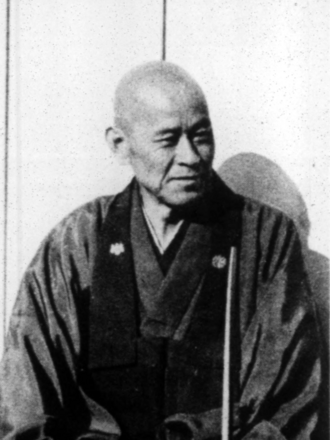
"After you have practiced for a while, you will realize that it is not possible to make rapid, extraordinary progress. Even though you try very hard, the progress you make is always little by little. It is not like going out in a shower in which you know when you get wet. In a fog, you do not know you are getting wet, but as you keep walking you get wet little by little. If your mind has ideas of progress, you may say, "Oh, this pace is terrible!" But actually it is not. When you get wet in a fog it is very difficult to dry yourself. So there is no need to worry about progress."
Shunryu Suzuki
Shunryu Suzuki
Shunryu Suzuki
author27 quotes

Shunryu Suzuki was a Sōtō Zen monk and teacher who helped popularize Zen Buddhism in the United States, and is renowned for founding the first Zen Buddhist monastery outside Asia. Suzuki founded San Francisco Zen Center which, along with its affiliate temples, comprises one of the most influential Zen organizations in the United States. A book of his teachings, Zen Mind, Beginner's Mind, is one of

More by Shunryu Suzuki

View all →
Quote
"Bowing is a very serious practice. You should be prepared to bow, even in your last moment. Even though it is impossible to get rid of our self-centered desires, we have to do it. Our true nature wants us to. After we bow to the floor nine times. By bowing we are giving up ourselves. To give up ourselves means to give up our dualistic ideas. So there is no difference between zazen practice and bowing. …, the founder of the , committed (ritual suicide by disembowelment) in 1591 at the order of his lord, Hideyoshi. Just before Rikyu took his own life he said, "When I have this sword there is no Buddha and no Patriarchs." He meant that when we have the sword of big mind, there is no dualistic world. The only thing which exists is this spirit. This kind of imperturbable spirit was always present in Rikyu’s tea ceremony. He never did anything in just a dualistic way; he was ready to die in each moment. In ceremony after ceremony he died, and he renewed himself. This is the spirit of the tea ceremony. This is how we bow."
Shunryu SuzukiShunryu Suzuki
Quote
"Practice does not mean that whatever you do, even lying down, is zazen. When the restrictions you have do not limit you, this is what we mean by practice…. When you sit, you will sit. When you eat, you will eat…. If you say,”It doesn’t matter,” it means that you are making some excuse to do something in your own way with your small mind. It means that you are to some particular thing or way. That is not what we mean when we say, “Just to sit is enough,” or “Whatever you do is zazen.” Of course, everything you do is zazen, but if so, there is no need to say it."
Shunryu SuzukiShunryu Suzuki
Quote
"Once I had left Eiheiji and been away for some time, coming back was different. I heard the various sounds of practice—the bells and the monks reciting the sutra—and I had a deep feeling. There were tears flowing out of my eyes, nose, and mouth! It is the people who are outside of the monastery who feel its atmosphere. Those who are practicing actually do not feel anything. I think this is true for everything. When we hear the sound of the pine trees on a windy day, perhaps the wind is just blowing, and the pine tree is just standing in the wind. That is all that they are doing. But the people who listen to the wind in the tree will write a poem, or will feel something unusual. That is, I think, the way everything is."
Shunryu SuzukiShunryu Suzuki
Quote
"You may say you attained some stage in your practice. But that is just a trivial event in your long life. It is like saying the ocean is round, or like a jewel, or palace. For a hungry ghost the ocean is a pool of blood; for a dragon the ocean is a palace; for a fish it is his house; for a human being it is water. There must be various understandings. When the ocean is a palace, it is a palace. You cannot say it is not a palace. For a dragon it is actually a palace. If you laugh at a fish who says it is a palace, Buddha will laugh at you who say it is two oclock, three oclock. It is the same thing."
Shunryu SuzukiShunryu Suzuki

More on Education And Success

View all →
Quote
"An [hypertext] encyclopaedia will be an overall attempt by the knowledgeable, the learned societies or anyone else, to represent the state-of-the-art in their field. An encyclopaedia will be a living document, as up to date as it can be, instantly accessible at any time. It will contain carefully authored explanations and summaries of the subject, as well as computer-generated indexes of literature. A reference to a paper from the encyclopaedia conveys authority and acceptance by academic society. A measure of a paper’s standing may be conveyed by the number of links it is away from an encyclopaedia."
Tim Berners-LeeTim Berners-Lee
Quote
"One of the first major steps in the direction of modern skepticism came through the victory of Occam over Aquinas in a controversy about language. The statement that modi essendi were replaced by modi significandi et intelligendi, or that ontological referents were abandoned in favor of pragmatic significations, describes broadly the change in philosophy which continues to our time. From Occam to Bacon, from Bacon to Hobbes, and from Hobbes to contemporary semanticists, the progression is clear: ideas become psychological figments, words become useful signs. ... To one completely committed to this realm of becoming, as are the empiricists, the claim to apprehend verities is a sign of . Probably we have here but a highly sophisticated expression of the doctrine that ideals are hallucination and that the only normal, sane person is the healthy extrovert, making instant, instinctive adjustments to the stimuli of the material world."
O
Ontology