SHAWORDS

An opinion can be argued with; a conviction is best shot. The logical — T. E. Lawrence

"An opinion can be argued with; a conviction is best shot. The logical end of a war of creeds is the final destruction of one, and Salammbo is the classical text-book instance."
T
T. E. Lawrence
T. E. Lawrence
author44 quotes

Thomas Edward Lawrence was a British Army officer, archaeologist, diplomat and writer known for his role during the Arab Revolt and Sinai and Palestine campaign against the Ottoman Empire in the First World War. The breadth and variety of his activities and associations, and Lawrence's ability to describe them vividly in writing, earned him international fame as Lawrence of Arabia, a title used fo

More by T. E. Lawrence

View all →
Quote
"The Bedouin could not look for God within him: he was too sure that he was within God. He could not conceive anything which was or was not God, Who alone was great; yet there was a homeliness, an everyday-ness of this climatic Arab God, who was their eating and their fighting and their lusting, the commonest of their thoughts, their familiar resource and companion, in a way impossible to those whose God is so wistfully veiled from them by despair of their carnal unworthiness of Him and by the decorum of formal worship. Arabs felt no incongruity in bringing God into the weaknesses and appetites of their least creditable causes. He was the most familiar of their words; and indeed we lost much eloquence when making Him the shortest and ugliest of our monosyllables. This creed of the desert seemed inexpressible in words, and indeed in thought. It was easily felt as an influence, and those who went into the desert long enough to forget its open spaces and its emptiness were inevitably thrust upon God as the only refuge and rhythm of being. The Bedawi might be a nominal Sunni, or a nominal Wahabi, or anything else in the Semitic compass, and he would take it very lightly, a little in the manner of the watchmen at Zions gate who drank beer and laughed in Zion because they were Zionists. Each individual nomad had his revealed religion, not oral or traditional or expressed, but instinctive in himself; and so we got all the Semitic creeds with (in character and essence) a stress on the emptiness of the world and the fullness of God; and according to the power and opportunity of the believer was the expression of them."
T
T. E. Lawrence
Quote
"[Lawrence and I] went up together with Mr. Churchill to Palestine… On the way we stopped at many wayside stations where Mr. Churchill was given vociferous welcomes. The first of these was at Gaza where there was a tremendous reception by a howling mob all shouting in Arabic ‘Cheers for the Minister’ and also for Great Britain, but their chief cry over which they waxed quite frenzied was ‘Down with the Jews’ and ‘Cut their throats.’ Mr. Churchill and Sir Herbert were delighted with the enthusiasm of their reception, being not in the least aware of what was being shouted. Lawrence, of course, understood it all and told me, but we kept very quiet. He was obviously gravely anxious about the whole situation… We finally got away from Gaza with a sigh of relief on the part of Lawrence and myself. Captain Maxwell Coote, Colonial Secretary Winston Churchill’s Orderly Officer, later recalled a frightening moment from the Cairo conference of 1921 where Lawrence served as Churchills advisor on Arab affairs. (A.W. Lawrence, T.E. Lawrence by His Friends, 235-6)"
T
T. E. Lawrence
Quote
"The Wahabis, followers of a fanatical Moslem heresy, had imposed their strict rules on easy and civilized Kasim. In Kasim there was but little coffee-hospitality, much prayer and fasting, no tobacco, no artistic dalliance with women, no silk clothes, no gold and silver head-ropes or ornaments. Everything was forcibly pious or forcibly puritanical. It was a natural phenomenon, this periodic rise at intervals of little more than a century, of ascetic creeds in Central Arabia. Always the votaries found their neighbours beliefs cluttered with inessential things, which became impious in the hot imagination of their preachers. Again and again they had arisen, had taken possession, soul and body, of the tribes, and had dashed themselves to pieces on the urban Semites, merchants and concupiscent men of the world. About their comfortable possessions the new creeds ebbed and flowed like the tides or the changing seasons, each movement with the seeds of early death in its excess of Tightness. Doubtless they must recur so long as the causes — sun, moon, wind, acting in the emptiness of open spaces, weigh without check on the unhurried and uncumbered minds of the desert-dwellers."
T
T. E. Lawrence

More on War

View all →
Quote
"I should say that when people talk about capitalism its a bit of a joke. Theres no such thing. No country, no business class, has ever been willing to subject itself to the free market, free market discipline. Free markets are for others. Like, the Third World is the Third World because they had free markets rammed down their throat. Meanwhile, the enlightened states, England, the United States, others, resorted to massive state intervention to protect private power, and still do. Thats right up to the present. I mean, the Reagan administration for example was the most protectionist in post-war American history. Virtually the entire dynamic economy in the United States is based crucially on state initiative and intervention: computers, the internet, telecommunication, automation, pharmaceutical, you just name it. Run through it, and you find massive ripoffs of the public, meaning, a system in which under one guise or another the public pays the costs and takes the risks, and profit is privatized. Thats very remote from a free market. Free market is like what India had to suffer for a couple hundred years, and most of the rest of the Third World."
N
Noam Chomsky
Quote
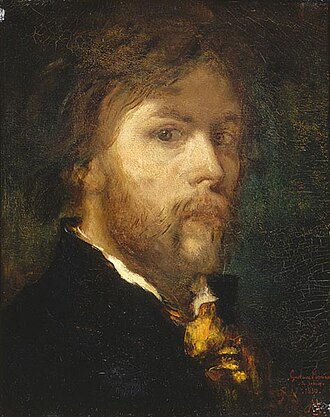
"I am dominated by one thing, an irresistible, burning attraction towards the abstract. The expression of human feelings and the passions of man certainly interest me deeply, but I am less concerned with expressing the motions of the soul and mind than to render visible, so to speak, the inner flashes of intuition which have something divine in their apparent insignificance and reveal magic, even divine horizons, when they are transposed into the marvellous effects of pure plastic art."
Gustave MoreauGustave Moreau