Quote
"My thought is that if some art is imitation and some art is not, neither term belongs to the definition of art as philosophically understood. A property is part of the definition only if it belongs to every work of art there is."
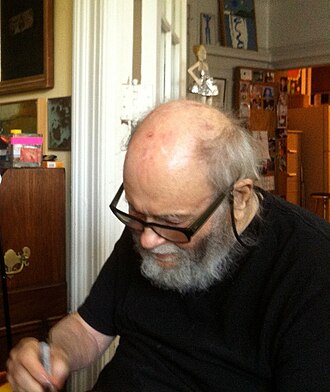 Arthur Danto
"As a philosopher, I would cherish an argument which demonstrates that the mind cannot be mapped onto the brain any better than the Sistine ceiling can be mapped onto the brushstrokes—and that Eliminativists are as misled as Colalucci. It would be great if the analogy itself were accepted, even if we did not know where to go from there."
Arthur Coleman Danto was an American art critic, philosopher, and professor at Columbia University. He was best known for having been a long-time art critic for The Nation and for his work in philosophical aesthetics and philosophy of history, though he contributed significantly to a number of fields, including the philosophy of action. His interests included thought, feeling, philosophy of art, t
"My thought is that if some art is imitation and some art is not, neither term belongs to the definition of art as philosophically understood. A property is part of the definition only if it belongs to every work of art there is."
Arthur Danto"There were limits to what art—composed of such genres as portraiture, landscape, still life, and historical painting (the latter of which, in royal academies, enjoyed the highest esteem)—could do to show movement."
Arthur Danto"It is true that art today is pluralistic. Pluralism was noticed by certain followers of Ludwig Wittgenstein. What makes art so powerful a force as it appears to be in song and story is due to what makes it art to begin with. There is really nothing like it when it comes to stirring the spirit."
Arthur Danto"Any movement can be a dance movement and hence achieve the dreamlike. The same may be true of acting, as when, for example, an actress serves cocktails that are actually glasses filled with just water. To taste the tasteless is a kind of bad dream. It is not possible to catalog all the different ways artists have found to dream-ify. I’ll take a flier at Michelangelo’s masterpiece, the great decoration of the Sistine Chapel’s vault, with the scenes of a narrative in which, when I first saw it, figures move in and out of an enveloping dark."
Arthur Danto"The body that feels thirst and hunger, passion, desire, and love. The body that we understand when we read the ancients describing men in battle, men and women in love and in grief. The body, I would say, that our artistic tradition dealt with so gloriously for so many centuries, and somewhat less gloriously in a certain kind of performance art today."
Arthur Danto"My sense, in bringing to art the double criteria of meaning and embodiment, is to bring to art a connection with cognizance: to what is possible and, to the faithful, to the actual. Gregory the Great spoke of the carved capitals in the Romanesque basilica as the Bible of the Illiterate: they show what the Bible tells us took place. They tell the uneducated what they are supposed to know. That is, they tell them what they are to believe as true. Beauty has nothing to do with it, though the capable carver presents the Queen of Sheba as the great beauty she was. It is possible that she looked that way. But it can be art without being beautiful at all. Beauty was an eighteenth century value."
Arthur Danto