SHAWORDS

As for doing good, that is one of the professions which are full. — Walden

HomeWaldenQuote
"As for doing good, that is one of the professions which are full."
Walden
Walden
Walden
author

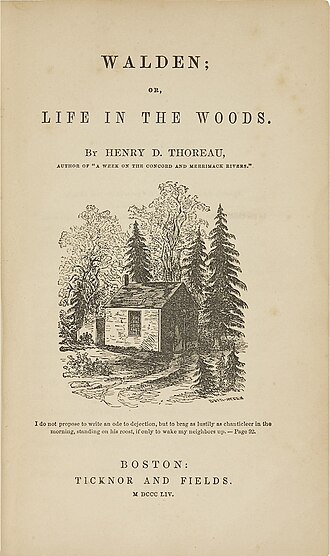
Walden is an 1854 book by American transcendentalist writer Henry David Thoreau. The text is a reflection upon the author's simple living in natural surroundings. The work is part personal declaration of independence, social experiment, voyage of spiritual discovery, satire, and—to some degree—a manual for self-reliance.

More by Walden

View all →
Quote
"I know of no more encouraging fact than the unquestionable ability of man to elevate his life by a conscious endeavor. It is something to be able to paint a particular picture, or to carve a statue, and so to make a few objects beautiful; but it is far more glorious to carve and paint the very atmosphere and medium through which we look, which morally we can do. To affect the quality of the day, that is the highest of arts. Every man is tasked to make his life, even in its details, worthy of the contemplation of his most elevated and critical hour."
WaldenWalden
Quote
"The one who came from farthest to my lodge, through deepest snows and most dismal tempests, was a poet. A farmer, a hunter, a soldier, a reporter, even a philosopher, may be daunted; but nothing can deter a poet, for he is actuated by pure love. Who can predict his comings and goings? His business calls him out at all hours, even when doctors sleep. We made that small house ring with boisterous mirth and resound with the murmur of much sober talk, making amends then to Walden vale for the long silences. Broadway was still and deserted in comparison. At suitable intervals there were regular salutes of laughter, which might have been referred indifferently to the last-uttered or the forth-coming jest. We made many a "bran new" theory of life over a thin dish of gruel, which combined the advantages of conviviality with the clear-headedness which philosophy requires."
WaldenWalden
Quote
"Our life is frittered away by detail. An honest man has hardly need to count more than his ten fingers, or in extreme cases he may add his ten toes, and lump the rest. Simplicity, simplicity, simplicity! I say, let your affairs be as two or three, and not a hundred or a thousand; instead of a million count half a dozen, and keep your accounts on your thumb-nail. In the midst of this chopping sea of civilized life, such are the clouds and storms and quicksands and thousand-and-one items to be allowed for, that a man has to live, if he would not founder and go to the bottom and not make his port at all, by dead reckoning, and he must be a great calculator indeed who succeeds. Simplify, simplify. Instead of three meals a day, if it be necessary eat but one; instead of a hundred dishes, five; and reduce other things in proportion."
WaldenWalden
Quote
"Still grows the vivacious lilac a generation after the door and lintel and the sill are gone, unfolding its sweet-scented flowers each spring, to be plucked by the musing traveller; planted and tended once by childrens hands, in front-yard plots -- now standing by wallsides in retired pastures, and giving place to new-rising forests; -- the last of that stirp, sole survivor of that family. Little did the dusky children think that the puny slip with its two eyes only, which they stuck in the ground in the shadow of the house and daily watered, would root itself so, and outlive them, and house itself in the rear that shaded it, and grown mans garden and orchard, and tell their story faintly to the lone wanderer a half-century after they had grown up and died -- blossoming as fair, and smelling as sweet, as in that first spring. I mark its still tender, civil, cheerful lilac colors."
WaldenWalden
Quote
"Now only a dent in the earth marks the site of these dwellings, with buried cellar stones, and strawberries, raspberries, thimble-berries, hazel-bushes, and sumachs growing in the sunny sward there; some pitch pine or gnarled oak occupies what was the chimney nook, and a sweet-scented black birch, perhaps, waves where the door-stone was. Sometimes the well dent is visible, where once a spring oozed; now dry and tearless grass; or it was covered deep -- not to be discovered till some late day -- with a flat stone under the sod, when the last of the race departed. What a sorrowful act must that be -- the covering up of wells! coincident with the opening of wells of tears. These cellar dents, like deserted fox burrows, old holes, are all that is left where once were the stir and bustle of human life, and "fate, free will, foreknowledge absolute," in some form and dialect or other were by turns discussed. But all I can learn of their conclusions amounts to just this, that "Cato and Brister pulled wool"; which is about as edifying as the history of more famous schools of philosophy."
WaldenWalden