Quote
"Nothing is so fatal to the progress of the human mind as to suppose that our views of science are ultimate; that there are no mysteries in nature; that our triumphs are complete, and that there are no new worlds to conquer."
H
Humphry Davy"As we all gratefully acknowledge, it is to the genius and labours of Faraday—Davys successor in this place—that the astonishing development of the application of electrical energy which characterises this age has taken rise."
Sir Humphry Davy, 1st Baronet was a British chemist and inventor who invented the Davy lamp and a very early form of arc lamp. He is also remembered for isolating, by using electricity, several elements for the first time: potassium and sodium in 1807 and calcium, strontium, barium, magnesium and boron the following year, as well as for discovering the elemental nature of chlorine and iodine. Davy
"Nothing is so fatal to the progress of the human mind as to suppose that our views of science are ultimate; that there are no mysteries in nature; that our triumphs are complete, and that there are no new worlds to conquer."
"Berthollets conclusion that chlorine is oxymuriatic acid was universally accepted until Gay-Lussac and Thénard in 1809 endeavoured to decompose the gas and failed. They concluded that it contained water because it yielded water when passed over litharge. Their researches read to the Institute in 1809 led Davy to investigate muriatic acid (hydrochloric acid) gas, which in 1808 he had shown to be decomposed by potassium, with evolution of hydrogen. In 1810 he proved that chlorine is an element, and that muriatic acid gas is a compound of chlorine and hydrogen. He thus overturned the oxygen-acid theory, and demonstrated that muriates are compounds of metals with chlorine. He pointed to the fact that some acids, such as sulphuretted hydrogen, contain no oxygen, and argued that muriatic acid gas was one of these, chlorine in it taking the place of oxygen. ...The conclusions of Davy were at first doubted, but when iodine and bromine were also discovered, Gay-Lussac and his followers adopted Davys views. The latter worked out fluorine, and proved that hydrofluoric acid (HF) contains no oxygen. Berzelius also opposed Davy until the discovery of iodine, but embraced the latters opinion in 1820."
"The moment after, I began to respire 20 quarts of unmingled nitrous oxide. A thrilling, extending from the chest to the extremities, was almost immediately produced. I felt a sense of tangible extension highly pleasurable in every limb; my visible impressions were dazzling, and apparently magnified, I heard distinctly every sound in the room and was perfectly aware of my situation. By degrees, as the pleasurable sensations increased, I last all connection with external things; trains of vivid visible images rapidly passed through my mind, and were connected with words in such a manner, as to produce perceptions perfectly novel. I existed in a world of newly connected and newly modified ideas. I theorised — I imagined that I made discoveries. When I was awakened from this semi-delirious trance by Dr. Kinglake, who took the bag from my mouth, indignation and pride were the first feelings produced by the sight of the persons about me. My emotions were enthusiastic and sublime; and for a minute I walked round the room, perfectly regardless of what was said to me. As I recovered my former state of mind, I felt an inclination to communicate the discoveries I had made during the experiment. I endeavoured to recall the ideas, they were feeble and indistinct; one collection of terms, however, presented itself: and with the most intense belief and prophetic manner, I exclaimed to Dr Kinglake, "Nothing exists but thoughts!—the universe is composed of impressions, ideas, pleasures and pains!"
"The general properties and chemical activities of potassium and sodium are so very similar that as a matter of commercial production that metal which can be most economically obtained is necessarily the one most largely manufactured, and of the two that metal is sodium. To-day, sodium is made by thousands of tons, and by a process which in principle is identical with that by which it was first made by Davy, i.e., by the of fused caustic soda."
"A sacred spark created by his breath, The immortal mind of man his image bears; A spirit living midst the forms of death, Oppressed, but not subdued, by mortal cares."
"I envy no quality of the mind or intellect in others; not genius, power, wit, nor fancy; but, if I could choose what would be most delightful, and, I believe, most useful to me, I should prefer a firm religious belief to every other blessing."
"In the life of the mass-order, the culture of the generality tends to conform to the demands of the average human being. Spirituality decays through being diffused among the masses when knowledge is impoverished in every possible way by rationalisation until it becomes accessible to the crude understanding of all."
"I say this to you because we Spaniards are a forgetful people, because we are used to living for the moment, because we do not look back, because we do not know how to see the chain of heroes, because we do not contemplate the sum of sacrifices."
 Francisco Franco
"Sharon Tate was my best friend. Once, we were roommates. She introduced me to my husband. She was the godmother to my baby daughter who is named for her. In the six years time that I knew her, she never said an unkind word about anyone."
"Long time to see. (VS: Tapion)"
"Most mathematicians prove what they can, von Neumann proves what he wants." Once in a discussion about the rapid growth of mathematics in modern times, von Neumann was heard to remark that whereas thirty years ago a mathematician could grasp all of mathematics, that is impossible today. Someone asked him: "What percentage of all mathematics might a person aspire to understand today?" Von Neumann went into one of his five-second thinking trances, and said: "About 28 percent."
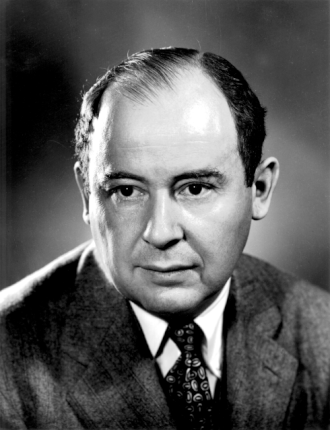 John von Neumann
"Children must be free to think in all directions irrespective of the peculiar ideas of parents who often seal their childrens minds with preconceived prejudices and false concepts of past generations. Unless we are very careful, very careful indeed, and very conscientious, there is still great danger that our children may turn out to be the same kind of people we are."