SHAWORDS

[B]ecause that which is finite is always bounded with reference to som — Aristotle

HomeAristotleQuote
"[B]ecause that which is finite is always bounded with reference to something... it is necessary that there should be no end... [N]umber also appears to be infinite, and mathematical magnitudes, and that which is beyond the heavens. And since that which is beyond is infinite, body also appears to be infinite, and it would seem that there are infinite worlds; for why is there rather void here than there? ...If also there is a vacuum, and an infinite place, it is necessary that there should be an infinite body: for in things which have a perpetual subsistence, capacity differs nothing from being. The speculation of the infinite is, however, attended with doubt: for many impossibilities happen both to those who do not admit that it has a subsistence, and to those who do. ...It is ...especially the province of a natural philosopher to consider if there be a sensible infinite magnitude."
Aristotle
Aristotle
Aristotle
author157 quotes

Aristotle was an ancient Greek philosopher and polymath. His writings span the natural sciences, philosophy, linguistics, economics, politics, psychology, and the arts. As the founder of the Peripatetic school of philosophy in the Lyceum in Athens, he began the wider Aristotelian tradition that followed, which set the groundwork for the development of modern science.

More by Aristotle

View all →
Quote
"I do believe for certain, that he [Aristotle] first procured, by the help of the senses, such experiments and observations as he could, to assure him as much as was possible of the conclusion, and that he afterwards sought out the means how to demonstrate it; for this is the usual course in demonstrative sciences. And the reason thereof is, because when the conclusion is true, by the help of the resolutive method, one may hit upon some proposition before demonstrated, or come to some principle known per se; but if the conclusion be false, a man may proceed in infinitum, and never meet with any truth already known."
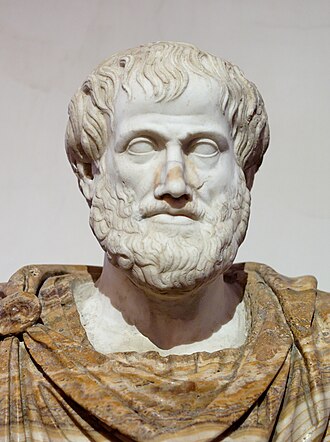
AristotleAristotle
Quote
"[I]ts gravity is the cause; and that which is heavy abides in the middle, and the earth is in the middle: in like manner also, the infinite will abide in itself, through some other cause... and will itself support itself. ...[T]he places of the whole and the part are of the same species; as of the whole earth and a clod, the place is downward; and of the whole of fire, and a spark, the place is upward. So that if the place of the infinite is in itself, there will be the same place also of a part of the infinite."
AristotleAristotle
Quote
"According to one mode... nature is thus denominated, viz. the first subject matter to every thing which contains in itself the principle of motion and mutation. But after another mode it is denominated form, which subsists according to definition: for as art is called that which subsists according to art, and that which is artificial; so likewise nature is both called that which is according to nature, and that which is natural. ...that which is composed from these is not nature, but consists from nature; as, for instance, man. And this is nature in a greater degree than matter: for every thing is then said to be, when it is form in energy... entelecheia, rather than when it is incapacity."
AristotleAristotle
Quote
"[T]he ancient philosophers... all of them assert that the elements, and those things which are called by them principles, are contraries, though they establish them without reason, as if they were compelled to assert this by truth itself. They differ, however... that some of them assume prior, and others posterior principles; and some of them things more known according to reason, but others such as are more known according to sense: for some establish the hot and the cold, others the moist and the dry, others the odd and the even, and others strife and friendship, as the causes of generation. ...in a certain respect they assert the same things, and speak differently from each other. They assert different things... but the same things, so far as they speak analogously. For they assume principles from the same co-ordination; since, of contraries, some contain, and others are contained."
AristotleAristotle