Quote
"At least, I got robbed by one of the best in the business. It’s like if you were a trainman in the old days and Jesse James held you up. You know you’ve been robbed by the best highwayman in the business."
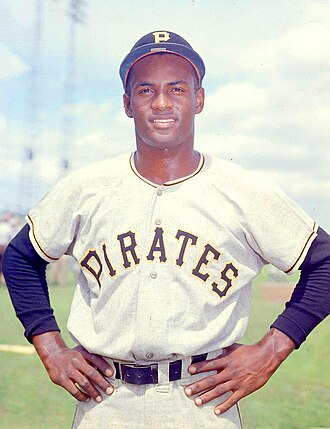 Roberto Clemente
"Clemente had the ability, no doubt about it, but he was, for instance, always trying to show off his arm. He was always trying to throw out runners at the plate, instead of throwing the ball to the cut-off man and preventing the hitter from taking the extra base. Instead of having runners at first and third, and still having the chance to get a double play, you’d have runners at second and third and no chance to get the double play. It makes it a lot tougher on the pitcher. He wouldn’t throw the ball down where Groat could grab it as the cut-off man or let it go if he thought Clemente’s throw could get the lead runner out. Clemente had a strong arm, but he was always trying to show it off. Early on, he used to throw the ball into the stands, but he got more accurate as he went on. He made some great throws and got some guys out, but there were more times he didn’t get the guy. Little things like that. As a player, you realize the significance of such things. The fan just sees him getting a guy out at home plate. But he did that two out of ten times. It looked great to the fans, and it was great for the Pirates if he got someone out like that. But more often than not, he was putting more pressure on the pitcher."
Roberto Enrique Clemente Walker was a Puerto Rican professional baseball player who played 18 seasons in Major League Baseball (MLB) for the Pittsburgh Pirates, primarily as a right fielder. On December 31, 1972, Clemente was killed when his Douglas DC-7 airplane, which he had chartered for a flight to take and deliver emergency relief goods for the survivors of a massive earthquake in Nicaragua,
"At least, I got robbed by one of the best in the business. It’s like if you were a trainman in the old days and Jesse James held you up. You know you’ve been robbed by the best highwayman in the business."
Roberto Clemente"Before I threw the ball I prayed a little bit to God: "Please let this pitch be in a good spot for him not to hit it too hard." I think I was lucky enough to throw the ball in a good spot. It was a ground ball out. I remember one time in Pittsburgh – I struck him out three times. I think that was the greatest day in my life."
Roberto Clemente"When he was throwing to third, his throw was low enough to hit the cutoff and still get to third in the air. Coming home sometimes, he’d miss the cutoff man and try to get it all the way to the plate. Didn’t hurt him because he got it there quicker than most people. Roberto was one of the very few right fielders who could field the ball with the runner rounding first and throw behind that runner, without him taking second. He threw out quite a few guys that way."
Roberto Clemente"What I did was mild compared to what Durocher did to Conlan. I dont see how what I did can be called more serious than the Durocher incident. I had good reason to lose my head. That was the second time they call me out on a play I thought I had beat. Thats enough to make anybody mad."
Roberto Clemente"I am having a plaque put on the front of my house. It will say, "To God, Mother, Father and Baseball."
Roberto Clemente"Clemente and Ted Williams are the only two batters I ever saw who get good wood on the ball almost every time up. Every ball he hits seems shot out of a cannon."
Roberto Clemente"As long as you keep getting born, it’s okay to die sometimes."
"The smart way to keep people passive and obedient is to strictly limit the spectrum of acceptable opinion, but allow very lively debate within that spectrum - even encourage the more critical and dissident views. That gives people the sense that theres free thinking going on, while all the time the presuppositions of the system are being reinforced by the limits put on the range of the debate."
"History is a strange experience. The world is quite small now; but history is large and deep. Sometimes you can go much farther by sitting in your own home and reading a book of history, than by getting onto a ship or an airplane and traveling a thousand miles. When you go to Mexico City through space, you find it a sort of cross between modern Madrid and modern Chicago, with additions of its own; but if you go to Mexico City through history, back only 500 years, you will find it as distant as though it were on another planet: inhabited by cultivated barbarians, sensitive and cruel, highly organized and still in the Copper Age, a collection of startling, of unbelievable contrasts."
"As soon as a thought or word becomes a tool, one can dispense with actually ‘thinking’ it, that is, with going through the logical acts involved in verbal formulation of it. As has been pointed out, often and correctly, the advantage of mathematics—the model of all neo-positivistic thinking—lies in just this ‘intellectual economy.’ Complicated logical operations are carried out without actual performance of the intellectual acts upon which the mathematical and logical symbols are based. … Reason … becomes a fetish, a magic entity that is accepted rather than intellectually experienced."
"Our feminist culture at the present moment is completely dependent on capitalism. My grandmother was still scrubbing clothes on the back porch on a washboard!"
"A word of the faith that never balks, Here or henceforward it is all the same to me, I accept Time absolutely. It alone is without flaw, it alone rounds and completes all, That mystic baffling wonder alone completes all. (23)"