SHAWORDS

Common ground! Think of Jerusalem, the intersection where many trails — Jerusalem

HomeJerusalemQuote
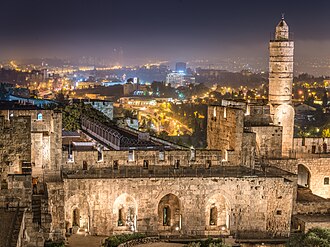
"Common ground! Think of Jerusalem, the intersection where many trails met. A small village that became the birthplace for three religions - Judaism, Christianity and Islam. Why was this village so blessed? Because it provided a crossroads there different people met, different cultures, different civilizations could meet and find common ground. When people come together, flowers always flourish - the air is rich with the aroma of a new spring."
Jerusalem
Jerusalem
Jerusalem
author50 quotes

Jerusalem is a city in the Southern Levant, on a plateau in the Judaean Mountains between the Mediterranean and the Dead Sea. It is one of the oldest cities in the world and is considered holy to the three major Abrahamic religions: Judaism, Christianity and Islam. Both Israel and Palestine claim Jerusalem as their capital city; Israel maintains its primary governmental institutions there, while P

More by Jerusalem

View all →
Quote
"“I suppose you must be looking forward to them sorting all this out,” he said. “Er. The Palestinian situation. The politics.” She shrugged. “It doesn’t matter to Jerusalem,” she said. “The people come. The people believe. Then they kill each other, to prove that God loves them.” “Well,” he said. “How would you fix it?” She smiled her whitest smile. “Sometimes,” she said, “I think it would be best if it was bombed. If it was bombed back to a radioactive desert. Then who would want it? But then I think, they would come here and collect the radioactive dust that might contain atoms of the Dome of the Rock, or of the Temple, or a wall that Christ leaned against on his way to the Cross. People would fight over who owns a poisonous desert, if that desert was Jerusalem."
JerusalemJerusalem
Quote
"When the clock of the Mosk needs repairing, they are compelled, however reluctantly to employ a Frank. But in order to have a clean conscience in the commission of such an abominable piece of sacrilege as the admission upon the sacred premises, they adopt the following expedient. The mechanic selected being thoroughly purged from his uncleanness ablution . . . a certain formula of prayer and incantation is sung over him at the gate. This being satisfactorily concluded, he is considered as exorcised, not only of Christianity (or Judaism, as the case may be), but of humanity also; and is declared to be no longer a man but a donkey. He is then mounted upon the shoulders of the faithful, lest . . . the ground should be polluted by his footsteps; and being carried to the spot where his labours are required, he is set down upon matting within certain prescribed limits; and the operation being performed, he is carried back to the gate, and there, by certain other ceremonies, he is duly undonkeyfied and transmuted back into a man again."
JerusalemJerusalem

More on Judai

View all →
Quote
"Just as Hillels actions were not based (even in theory) on any reasoned ethical system, so his moral teaching did not take the form of a systematic treatise, but was expressed in aphorisms, which were, no doubt, occasioned by particular circumstances, but have none the less a universal value. This value, indeed, is not for the doubter, who must needs either find a rational basis for morality, or discard it. They appeal to those who accept, as Hillel accepted, the fundamental postulates of Judaism; and their claim to universality rests, therefore, on the extent to which those postulates are in accord with the root facts of human nature. They are interpretative, not speculative. The moral sayings of Hillel recorded in the Talmud are few in number, but they embody with sufficient fulness the point of view which was expressed no less fully in his conduct. They are contained almost exclusively in the first two chapters of the "Ethics of the Fathers."
H
Hillel the Elder
Quote
"Clever though be the many thoughts expressed by mouth or pen about the invention of money and its enormous value as a civiliser, against such praises should be set the curse to which it has always been doomed in song and legend. If gold here figures as the demon strangling manhoods innocence, our greatest poet shews at last the goblins game of paper money. The Nibelungs fateful ring become a pocket-book, might well complete the eerie picture of the spectral world-controller. By the advocates of our Progressive Civilisation this rulership is indeed regarded as a spiritual, nay, a moral power; for vanished Faith is now replaced by "Credit," that fiction of our mutual honesty kept upright by the most elaborate safeguards against loss and trickery. What comes to pass beneath the benedictions of this Credit we now are witnessing, and seem inclined to lay all blame upon the Jews. They certainly are virtuosi in an art which we but bungle: only, the coinage of money out of nil was invented by our Civilisation itself; or if the Jews are blamable for that, it is because our entire civilisation is a barbaro-judaic medley, in nowise a Christian creation."
Richard WagnerRichard Wagner
Quote
"A man who is convinced of the truth of his religion is indeed never tolerant. At the least, he is to feel pity for the adherent of another religion but usually it does not stop there. The faithful adherent of a religion will try first of all to convince those that believe in another religion and usually he goes on to hatred if he is not successful. However, hatred then leads to persecution when the might of the majority is behind it. In the case of a Christian clergyman, the tragic-comical is found in this: that the Christian religion demands love from the faithful, even love for the enemy. This demand, because it is indeed superhuman, he is unable to fulfill. Thus intolerance and hatred ring through the oily words of the clergyman. The love, which on the Christian side is the basis for the conciliatory attempt towards Judaism is the same as the love of a child for a cake. That means that it contains the hope that the object of the love will be eaten up..."
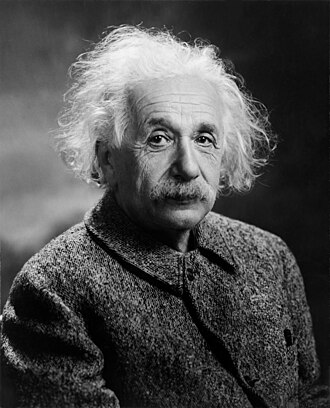
Albert EinsteinAlbert Einstein