Quote
"Cet enseignement, cest quil faut vivre comme on pense, sinon, tôt ou tard, on finit par penser comme on a vécu. (This teaching is to live as we think, otherwise, sooner or later, we end up thinking as we lived.)"
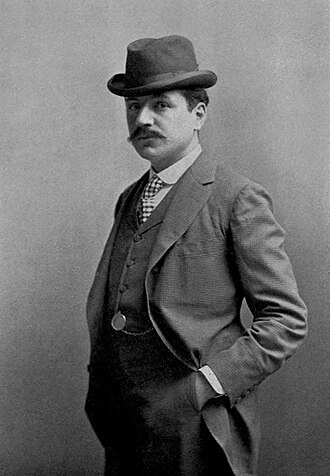 Paul Bourget
"Could she not obtain from him the promise to discharge his weapon in the air, if the duel was with pistols, or, if it was with swords, simply to disarm his enemy? Like nearly all persons unversed in the art, she believed in infallible fencers, in marksmen who never missed their aim, and she had also ideas profoundly, absolutely inexact on the relations of one man with another in the matter of an insult."
Paul Charles Joseph Bourget was a French poet, novelist and critic. He was nominated for the Nobel Prize in Literature five times.
"Cet enseignement, cest quil faut vivre comme on pense, sinon, tôt ou tard, on finit par penser comme on a vécu. (This teaching is to live as we think, otherwise, sooner or later, we end up thinking as we lived.)"
Paul Bourget"I have been thinking about our conversation and about your book, and I am afraid that I expressed myself badly yesterday. When I said that one may love and be loved at any age I ought to have added that sometimes this love comes too late. It comes when one no longer has the right to prove to the loved one how much she is loved, except by loves sacrifice."
Paul Bourget"I listened while he thought aloud and had almost forgotten my Machiavellian combination, so keen was my relish of the joyous intimacy of this communion with a mind I had passionately loved in his works. He was the first of the great writers of our day whom I had thus approached on something like terms of intimacy. As we talked I observed the strange similarity between his spoken and his written words. I admired the charming simplicity with which he abandoned himself to the pleasures of imagination, his superabundant intelligence, the liveliness of his impressions and his total absence of arrogance and of pose."
Paul Bourget"Is there any God, any justice, is there either good or evil? None, none, none, none! There is nothing but a pitiless destiny which broods over the human race, iniquitous and blind, distributing joy and grief at haphazard. A God who says, "Thou shalt not kill," to him whose father has been killed? No, I dont believe it. No, if hell were there before me, gaping open, I would make answer: "I have done well," and I would not repent. I do not repent. My remorse is not for having seized the weapon and struck the blow, it is that I owe to him — to him — that infamous good service which he did me — that I cannot to the present hour shake from me the horrible gift I have received from that man. If I had destroyed the paper, if I had gone and given myself up, if I had appeared before a jury, revealing, proclaiming my deed, I should not be ashamed; I could still hold up my head. What relief, what joy it would be if I might cry aloud to all men that I killed him, that he lied, and I lied, that it was I, I, who took the weapon and plunged it into him! And yet, I ought not to suffer from having accepted — no — endured the odious immunity. Was it from any motive of cowardice that I acted thus? What was I afraid of? Of torturing my mother, nothing more. Why, then, do I suffer this unendurable anguish? Ah, it is she, it is my mother who, without intending it, makes the dead so living to me, by her own despair. She lives, shut up in the rooms where they lived together for sixteen years; she has not allowed a single article of furniture to be touched; she surrounds the mans accursed memory with the same pious reverence that my aunt formerly lavished on my unhappy father. I recognize the invincible influence of the dead in the pallor of her cheeks, the wrinkles in her eyelids, the white streaks in her hair. He disputes her with me from the darkness of his coffin; he takes her from me, hour by hour, and I am powerless against that love."
Paul Bourget"The forests have taught man liberty."
Paul Bourget"There are some surely whom you like and whom you dislike, for whom you entertain esteem and for whom you feel contempt? Have you not thought that you have some duties toward them, that you can aid them in leading better lives?"
Paul Bourget