Quote
"Hello snotface!! Yuk! What happened to you? Look at you, youre all older, youre even uglier. Euck! Im sorry, Im going to have to be sick all over you immediately, lie down."
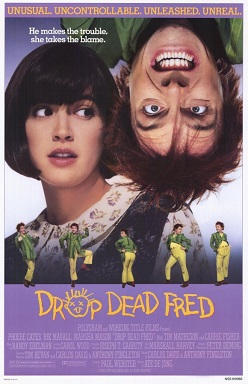 Drop Dead Fred
"Dishes. Relationships. Wind. This guy breaks everything."
Drop Dead Fred is a 1991 black comedy fantasy film directed by Ate de Jong, produced by PolyGram and Working Title Films and released and distributed by New Line Cinema, starring Phoebe Cates as a young woman named Elizabeth Cronin and Rik Mayall as her imaginary friend, Drop Dead Fred, with Marsha Mason, Tim Matheson and Carrie Fisher in supporting roles. It follows Elizabeth as she is haunted by
"Hello snotface!! Yuk! What happened to you? Look at you, youre all older, youre even uglier. Euck! Im sorry, Im going to have to be sick all over you immediately, lie down."
Drop Dead Fred"You have to go alone...I cant get back now."
Drop Dead Fred"Ashley Peldon - Young Elizabeth"
Drop Dead Fred"[looking up Mothers skirt off-screen] Look, cobwebs!"
Drop Dead Fred"Marsha Mason - Polly (Mother) Cronin"
Drop Dead Fred"Phoebe Cates - Elizabeth Cronin"
Drop Dead Fred"Space and time are commonly regarded as the forms of existence of the real world, matter as its substance. A definite portion of matter occupies a definite part of space at a definite moment of time. It is in the composite idea of motion that these three fundamental conceptions enter into intimate relationship."
"[Relationships] never seem to work out, I mean it gets to the point where I have to be extremely cautious. You have to understand, this stardom thing is still new to me, I dont even consider myself "famous". Its 2008: if you have a blog, a mixtape and two pairs of skinny jeans you, too, can be famous."
"At the heart of liberty is the right to define ones own concept of existence, of meaning, of the universe, and of the mystery of human life....[P]eople have organized intimate relationships and made choices that define their views of themselves and their places in society, in reliance on the availability of abortion in the event that contraception should fail…. We conclude the line should be drawn at viability, so that, before that time, the woman has a right to choose to terminate her pregnancy....[T]here is no line other than viability which is more workable. To be sure, as we have said, there may be some medical developments that affect the precise point of viability, but this is an imprecision within tolerable limits....A husband has no enforceable right to require a wife to advise him before she exercises her personal choices."
"Only the most willful blindness could obscure the fact that sexual intimacy is a “sensitive, key relationship of human existence, central to family life, community welfare, and the development of the personality.” The fact that individuals define themselves in a significant way through their intimate sexual relationships with others suggests, in a Nation as diverse as ours, that there may be many “right” ways of conducting those relationships, and that much of the richness of a relationship will come from the freedom an individual has to choose the form and nature of these intensely personal bonds."
"The ideas set forth by organismic biologists during the first half of the twentieth century helped to give birth to a new way of thinking — "systems thinking" — in terms of connectedness, relationships, context. According to the systems view, the essential properties of an organism, or living system, are properties of the whole, which none of the parts have. They arise from the interactions and relationships among the parts. These properties are destroyed when the system is dissected, either physically or theoretically, into isolated elements. Although we can discern individual parts in any system, these parts are not isolated, and the nature of the whole is always different from the mere sum of its parts. The systems view of life is illustrated beautifully and abundantly in the writings of Paul Weiss, who brought systems concepts to the life sciences from his earlier studies of engineering and spent his whole life exploring and advocating a full organismic conception of biology."
"It seems clear that [set theory] violates against the essence of the continuum, which, by its very nature, cannot at all be battered into a single set of elements. Not the relationship of an element to a set, but of a part to a whole ought to be taken as a basis for the analysis of a continuum."