Quote
"For the anarchist, rebellion is not only a statement of will but a statement of rightness and truth."
A
Anarchism"Dismantling the state is a core element of almost all left-anarchist thinking. Of course, thats a goal. It doesnt mean that this society should not be organized and governed; it should be, but by democratic institutions, based on natural modes of association. Here, incidentally, you begin to get differences of points of view and ideas, as to how human life and society should be organized. Theres no doctrine. Its not like Marxism and Leninism where there are some books you read and thats what you believe. This is a tendency in thinking, nobody owns it. Its all generally based on the idea that hierarchic and authoritarian structures are not self-justifying. They have to have a justification. So if there is a relation of subordination and domination, maybe you can justify it, but theres a strong burden of proof on anybody who tries to justify it. Quite commonly, the justification cant be given. Its a relationship that is maintained by obedience, by force, by tradition, by one or another form of sometimes physical, sometimes intellectual or moral coercion. If so, it ought to be dismantled. People ought to become liberated and discover that they are under a form of oppression which is illegitimate, and move to dismantle it. What happens next? We dont really know. There are people who think they know the answer. Im not one of them. My view is, we dont understand very much about human beings or human affairs, so anything that would be done has to be experimentally tried, but I think there are some leading ideas that make some good sense."
Anarchism is a political philosophy and movement that seeks to abolish all institutions that perpetuate authority, coercion, or hierarchy, primarily targeting the state and capitalism. Anarchism advocates for the replacement of the state with stateless societies and voluntary free associations. Anarchism is described as being part of the libertarian wing of the socialist movement.
"For the anarchist, rebellion is not only a statement of will but a statement of rightness and truth."
"How ill we go on like human beings eating and sleeping, working and loving, exchanging and dealing, without government? So used have we become to "organized authority" in every department of life that ordinarily we cannot conceive of the most common-place avocations being carried on without their interference and "protection." But anarchism is not compelled to outline a complete organization of a free society. To do so with any assumption of authority would be to place another barrier in the way of coming generations. The best thought of today may become the useless vagary of tomorrow, and to crystallize it into a creed is to make it unwieldy."
"There is no governor anywhere; you are all absolutely free. There is no restraint that cannot be escaped. We are all absolutely free. If everybody could go into dhyana at will, nobody could be controlled — by fear of prison, by fear of whips or electroshock, by fear of death, even. All existing society is based on keeping those fears alive, to control the masses. Ten people who know would be more dangerous than a million armed anarchists."
"My early work is politically anarchist fiction, in that I was an anarchist for a long period of time. Im not an anarchist any longer, because Ive concluded that anarchism is an impractical ideal. Nowadays, I regard myself as a libertarian. I suppose an anarchist would say, paraphrasing what Marx said about agnostics being "frightened atheists," that libertarians are simply frightened anarchists. Having just stated the case for the opposition, I will go along and agree with them: yes, I am frightened. Im a libertarian because I dont trust the people as much as anarchists do. I want to see government limited as much as possible; I would like to see it reduced back to where it was in Jeffersons time, or even smaller. But I would not like to see it abolished. I think the average American, if left totally free, would act exactly like Idi Amin. I dont trust the people any more than I trust the government."
"The anarchists put the thing upside down. They declare that the proletarian revolution must begin by doing away with the political organization of the state. But to destroy it at such a moment would be to destroy the only organism by means of which the victorious proletariat can assert its newly-conquered power, hold down its capitalist adversaries, and carry out that economic revolution of society without which the whole victory must end in a new defeat and a mass slaughter of the workers similar to those after the Paris commune."
"If no one works for you, no one decides for you."
"In the life of the mass-order, the culture of the generality tends to conform to the demands of the average human being. Spirituality decays through being diffused among the masses when knowledge is impoverished in every possible way by rationalisation until it becomes accessible to the crude understanding of all."
"The first thing I remember about the world — and I pray that it may be the last — is that I was a stranger in it. This feeling, which everyone has in some degree, and which is, at once, the glory and desolation of homo sapiens, provides the only thread of consistency that I can detect in my life."
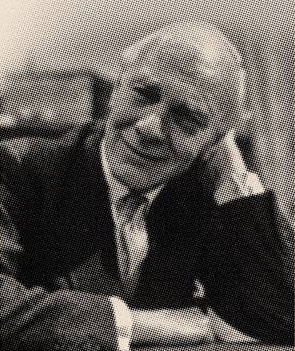 Malcolm Muggeridge
"Jewish custom, which traces descent solely from the mother, is more sensible and more discreet. Our own lawgivers cant accept the fact that there are many things in family life that are best kept shrouded in mystery."
"One makes mistakes; that is life. But it is never a mistake to have loved."
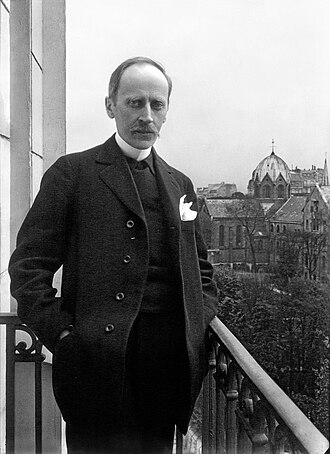 Romain Rolland
"If it fulfills our hopes, this center will be, at once, a symbol and a reflection and a hope. It will symbolize our belief that the world of creation and thought are at the core of all civilization. Only recently in the White House we helped commemorate the 400th anniversary of Shakespeare. The political conflicts and ambitions of his England are known to the scholar and to the specialist. But his plays will forever move men in every corner of the world. The leaders that he wrote about live far more vividly in his words than in the almost forgotten facts of their own rule. Our civilization, too, will largely survive in the works of our creation. There is a quality in art which speaks across the gulf dividing man from man and nation from nation, and century from century. That quality confirms the faith that our common hopes may be more enduring than our conflicting hostilities. Even now men of affairs are struggling to catch up with the insights of great art. The stakes may well be the survival of civilization. The personal preferences of men in government are not important--except to themselves. However, it is important to know that the opportunity we give to the arts is a measure of the quality of our civilization. It is important to be aware that artistic activity can enrich the life of our people, which really is the central object of Government. It is important that our material prosperity liberate and not confine the creative spirit."
"I did not go to join Kurtz there and then. I did not. I remained to dream the nightmare out to the end, and to show my loyalty to Kurtz once more. Destiny. My destiny! Droll thing life is — that mysterious arrangement of merciless logic for a futile purpose. The most you can hope from it is some knowledge of yourself — that comes too late — a crop of unextinguishable regrets. I have wrestled with death. It is the most unexciting contest you can imagine. It takes place in an impalpable grayness, with nothing underfoot, with nothing around, without spectators, without clamor, without glory, without the great desire of victory, without the great fear of defeat, in a sickly atmosphere of tepid skepticism, without much belief in your own right, and still less in that of your adversary. If such is the form of ultimate wisdom, then life is a greater riddle than some of us think it to be. I was within a hairs-breadth of the last opportunity for pronouncement, and I found with humiliation that probably I would have nothing to say. This is the reason why I affirm that Kurtz was a remarkable man. He had something to say. He said it. Since I had peeped over the edge myself, I understand better the meaning of his stare, that could not see the flame of the candle, but was wide enough to embrace the whole universe, piercing enough to penetrate all the hearts that beat in the darkness. He had summed up — he had judged. The horror! He was a remarkable man. After all, this was the expression of some sort of belief; it had candor, it had conviction, it had a vibrating note of revolt in its whisper, it had the appalling face of a glimpsed truth — the strange commingling of desire and hate."