Quote
"La vraie éloquence se moque de léloquence, la vraie morale se moque de la morale."
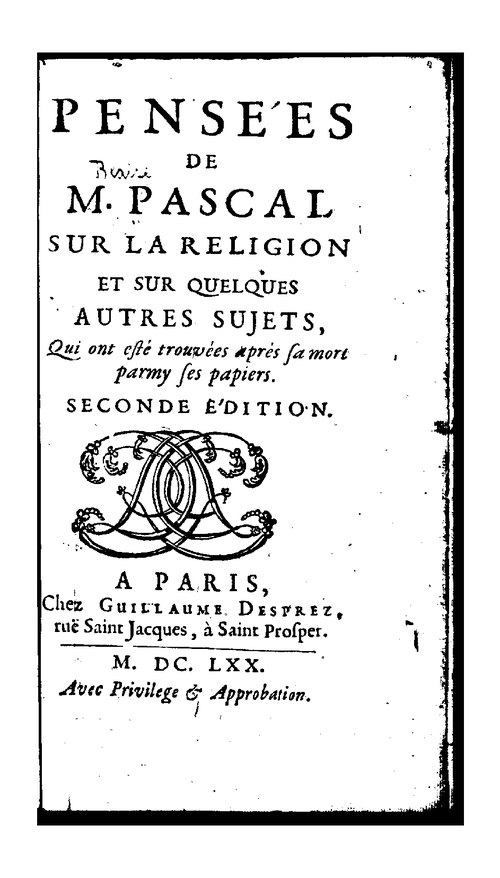 Pensées
"Diversion.—When I have occasionally set myself to consider the different distractions of men, the pains and perils to which they expose themselves at court or in war, whence arise so many quarrels, passions, bold and often bad ventures, etc., I have discovered that all the unhappiness of men arises from one single fact, that they cannot stay quietly in their own chamber. A man who has enough to live on, if he knew how to stay with pleasure at home, would not leave it to go to sea or to besiege a town. A commission in the army would not be bought so dearly, but that it is found insufferable not to budge from the town; and men only seek conversation and entering games, because they cannot remain with pleasure at home. But on further consideration, when, after finding the cause of all our ills, I have sought to discover the reason of it, I have found that there is one very real reason, namely, the natural poverty of our feeble and mortal condition, so miserable that nothing can comfort us when we think of it closely."
The Pensées (Thoughts) is a collection of fragments written by the French 17th-century philosopher and mathematician Blaise Pascal. Pascal's religious conversion led him into a life of asceticism, and the Pensées was in many ways his life's work. It represented Pascal's defense of the Christian religion, and the concept of "Pascal's wager" stems from a portion of this work.
"La vraie éloquence se moque de léloquence, la vraie morale se moque de la morale."
Pensées"...no one is offended at not seeing everything; but one does not like to be mistaken, and that perhaps arises from the fact that man naturally cannot see everything, and that naturally he cannot err in the side he looks at, since the perceptions of our senses are always true."
Pensées"There are then two kinds of intellect: the one able to penetrate acutely and deeply into the conclusions of given premises, and this is the precise intellect; the other able to comprehend a great number of premises without confusing them, and this is the mathematical intellect. The one has force and exactness, the other comprehension. Now the one quality can exist without the other; the intellect can be strong and narrow, and can also be comprehensive and weak."
Pensées"...it is to judgment that perception belongs, as science belongs to intellect. Intuition is the part of judgment, mathematics of intellect."
Pensées"Se moquer de la philosophie, cest vraiment philosopher"
Pensées"Scepticism.—I shall here write my thoughts without order, and not perhaps in unintentional confusion; that is the true order, which will always indicate my object by its very disorder. I should do too much honor to my subject, if I treated it with order, since I want to show that it is incapable of it."
Pensées