Quote
"A little knowledge is a dangerous thing. So is a lot."
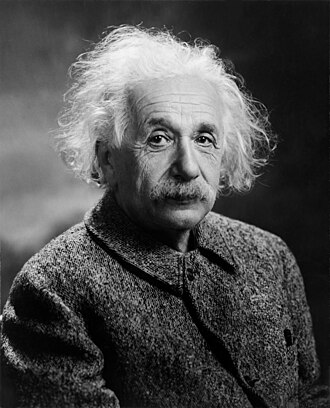 Albert Einstein
"Einstein asked himself a question... how can the sun and the Earth "attract" each other without touching..? ...[H]e imagined that the sun and the Earth each modified the space and time that surrounded them, just as a body in water displaces the water... This modification of the structure of time influences in turn the movement of the bodies, causing them to "fall" toward one another. ...The Earth is a large mass and slows down time in its vicinity. ...If things fall, it is due to this slowing of time. ...Where time passes uniformly, in interplanetary space, things do not fall. ...[H]ere on ...our planet, the movement of things inclines naturally toward where time passes more slowly, as when we run ...into the sea and the resistance of the water on our legs makes us fall headfirst... [T]ime passes more slowly for your feet than it does for your head."
Albert Einstein was a German-born theoretical physicist best known for developing the theory of relativity. Einstein also made important contributions to quantum theory. His mass–energy equivalence formula E = mc2, which arises from special relativity, has been called "the world's most famous equation". He received the 1921 Nobel Prize in Physics for "his services to theoretical physics, and espec
"A little knowledge is a dangerous thing. So is a lot."
Albert Einstein"Ich glaube an Spinozas Gott, der sich in der gesetzlichen Harmonie des Seienden offenbart, nicht an einen Gott, der sich mit Schicksalen und Handlungen der Menschen abgibt."
Albert Einstein"Sometimes one pays most for the things one gets for nothing."
Albert Einstein"My political ideal is Democratic ... Force always attracts men of low morality."
Albert Einstein"I never failed in mathematics. Before I was fifteen I had mastered differential and integral calculus."
Albert Einstein"Even on the most solemn occasions I got away without wearing socks and hid that lack of civilisation in high boots."
Albert Einstein"In the life of the mass-order, the culture of the generality tends to conform to the demands of the average human being. Spirituality decays through being diffused among the masses when knowledge is impoverished in every possible way by rationalisation until it becomes accessible to the crude understanding of all."
"I say this to you because we Spaniards are a forgetful people, because we are used to living for the moment, because we do not look back, because we do not know how to see the chain of heroes, because we do not contemplate the sum of sacrifices."
 Francisco Franco
"Sharon Tate was my best friend. Once, we were roommates. She introduced me to my husband. She was the godmother to my baby daughter who is named for her. In the six years time that I knew her, she never said an unkind word about anyone."
"Long time to see. (VS: Tapion)"
"Most mathematicians prove what they can, von Neumann proves what he wants." Once in a discussion about the rapid growth of mathematics in modern times, von Neumann was heard to remark that whereas thirty years ago a mathematician could grasp all of mathematics, that is impossible today. Someone asked him: "What percentage of all mathematics might a person aspire to understand today?" Von Neumann went into one of his five-second thinking trances, and said: "About 28 percent."
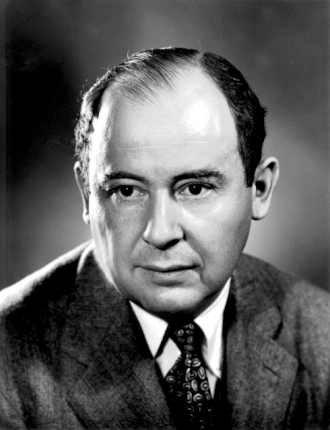 John von Neumann
"Children must be free to think in all directions irrespective of the peculiar ideas of parents who often seal their childrens minds with preconceived prejudices and false concepts of past generations. Unless we are very careful, very careful indeed, and very conscientious, there is still great danger that our children may turn out to be the same kind of people we are."