SHAWORDS

Five months into the war, although a million were already dead, the tr — World War I

HomeWorld War IQuote
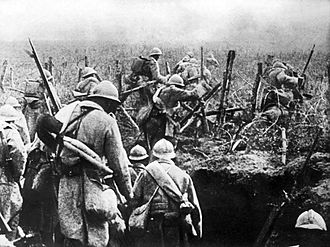
"Five months into the war, although a million were already dead, the trenches remained graves for the living. On both sides in 1915 there would be more dead on any single day than yards gained in the entire year. And there would be nearly four more years of attrition — not to determine who was right, but who was left."
World War I
World War I
World War I
author

World War I, or the First World War, also known as The Great War, was a global conflict between two coalitions: the Allies and the Central Powers. Major areas of conflict included Europe and the Middle East, as well as parts of Africa and the Asia-Pacific. The war saw important developments in weaponry including tanks, aircraft, artillery, machine guns, and chemical weapons. One of the deadliest c

More by World War I

View all →
Quote
"On June 28, 1914 a tubercular nineteen-year-old Bosnian youth named Gavrilo Princip carried out one of the most successful terrorist acts in all history. The shots he fired that day not only severed fatally the jugular vein of the Archduke Francis Ferdinand, the Habsburg heir to the thrones of Austria and Hungary. They also precipitated a war that destroyed the Austro-Hungarian Empire and transformed Bosnia-Herzegovina from one of its colonies into a part of a new South Slav state. These were in fact more or less precisely the things Princip had hoped to achieve, even if he cannot have anticipated such far-reaching success. Yet these were only the intended consequences of his action. The war he triggered was not confined to the Balkans; it also drew broad and hideous scars across northern Europe and the Near East. Like gargantuan abattoirs, its battlefields sucked in and slaughtered young men from all the extremities of the globe, claiming in all nearly ten million lives. It brought forth new and terrible methods of destruction, hitherto the stuff of Wellsian science-fiction: cavalry charges by armed and armoured vehicles, lethal clouds of poison gas, invisible fleets of submarines. It rained down bombs from the air and cluttered the Atlantic seabed with sunken ships. It lasted longer than any major war in Europe in living memory, dragging on for four and a quarter years. And, besides the Habsburgs, it toppled three other imperial dynasties: the Romanovs, the Hohenzollerns and the Ottomans. Even when an armistice was proclaimed, the war refused to stop; it swept eastwards after 1918, as if eluding the grasp of the peacemakers."
World War IWorld War I
Quote
"The First World War changed everything. In the summer of 1914 the world economy was thriving in ways that look distinctly familiar. The mobility of commodities, capital and labour reached levels comparable with those we know today; the sea lanes and telegraphs across the Atlantic were never busier, as capital and migrants went west and raw materials and manufactures went east. The war sank globalization - literally. Nearly thirteen million tons of shipping went to the bottom of the sea as a result of German naval action, most of it by U-boats. International trade, investment and emigration all collapsed. In the wars aftermath, revolutionary regimes arose that were fundamentally hostile to international economic integration. Plans replaced the market; autarky and protection took the place of free trade. Flows of goods diminished; flows of people and capital all but dried up. The European empires grip on the world - which had been the political undergirding of globalization - was dealt a profound, if not quite fatal, blow. The reverberations of Princips shots truly shook the world."
World War IWorld War I
Quote
"After the end of the World War of 1914 there was a deep conviction and almost universal hope that peace would reign in the world. The hearts desire of all the peoples could have easily been gained by steadfastness in righteous convictions, and by reasonable common sense and prudence. The phrase "the war to end war" was on every lip, and measures had been taken to turn it into reality. President Wilson, wielding, as was thought, the authority of the United States, had made the conception of a League of Nations dominant in all minds. The British Delegation at Versailles moulded and shaped his idea into an Instrument which will for ever constitute a milestone in the hard march of man. The victorious Allies were at that time all-powerful, so far as their outside enemies were concerned. They had to face grave internal difficulties and many riddles to which they did not know the answer, but the Teutonic Powers in the great mass of Central Europe were prostrate before them, and Russia, already shattered by the German flail, was convulsed by civil war and falling into the grip of the Bolshevik or Communist Party."
World War IWorld War I