SHAWORDS
World War I

World War I

World War I

World War I

author
59Quotes

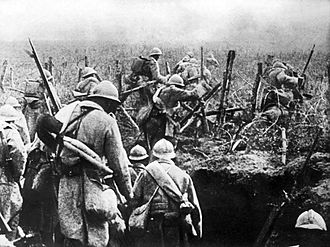
World War I, or the First World War, also known as The Great War, was a global conflict between two coalitions: the Allies and the Central Powers. Major areas of conflict included Europe and the Middle East, as well as parts of Africa and the Asia-Pacific. The war saw important developments in weaponry including tanks, aircraft, artillery, machine guns, and chemical weapons. One of the deadliest c

Popular Quotes

59 total
Quote
"On June 28, 1914 a tubercular nineteen-year-old Bosnian youth named Gavrilo Princip carried out one of the most successful terrorist acts in all history. The shots he fired that day not only severed fatally the jugular vein of the Archduke Francis Ferdinand, the Habsburg heir to the thrones of Austria and Hungary. They also precipitated a war that destroyed the Austro-Hungarian Empire and transformed Bosnia-Herzegovina from one of its colonies into a part of a new South Slav state. These were in fact more or less precisely the things Princip had hoped to achieve, even if he cannot have anticipated such far-reaching success. Yet these were only the intended consequences of his action. The war he triggered was not confined to the Balkans; it also drew broad and hideous scars across northern Europe and the Near East. Like gargantuan abattoirs, its battlefields sucked in and slaughtered young men from all the extremities of the globe, claiming in all nearly ten million lives. It brought forth new and terrible methods of destruction, hitherto the stuff of Wellsian science-fiction: cavalry charges by armed and armoured vehicles, lethal clouds of poison gas, invisible fleets of submarines. It rained down bombs from the air and cluttered the Atlantic seabed with sunken ships. It lasted longer than any major war in Europe in living memory, dragging on for four and a quarter years. And, besides the Habsburgs, it toppled three other imperial dynasties: the Romanovs, the Hohenzollerns and the Ottomans. Even when an armistice was proclaimed, the war refused to stop; it swept eastwards after 1918, as if eluding the grasp of the peacemakers."
World War IWorld War I
Quote
"My countrymen, there isnt anything the matter with the worlds civilization except that humanity is viewing it through a vision impaired in a cataclysmal war. Poise has been disturbed, and nerves have been wracked, and fever has rendered men irrational. Sometimes there have been draughts upon the dangerous cup of barbarity. Men have wandered far from safe paths, but the human procession still marches in the right direction. Here in the United States we feel the reflex, rather than the hurting wound itself, but we still think straight; and we mean to act straight; we mean to hold firmly to all that was ours when war involved us and seek the higher attainments which are the only compensations that so supreme a tragedy may give mankind."
World War IWorld War I
Quote
"The First World War changed everything. In the summer of 1914 the world economy was thriving in ways that look distinctly familiar. The mobility of commodities, capital and labour reached levels comparable with those we know today; the sea lanes and telegraphs across the Atlantic were never busier, as capital and migrants went west and raw materials and manufactures went east. The war sank globalization - literally. Nearly thirteen million tons of shipping went to the bottom of the sea as a result of German naval action, most of it by U-boats. International trade, investment and emigration all collapsed. In the wars aftermath, revolutionary regimes arose that were fundamentally hostile to international economic integration. Plans replaced the market; autarky and protection took the place of free trade. Flows of goods diminished; flows of people and capital all but dried up. The European empires grip on the world - which had been the political undergirding of globalization - was dealt a profound, if not quite fatal, blow. The reverberations of Princips shots truly shook the world."
World War IWorld War I
Quote
"[T]o claim that the over 100,000 American soldiers who died on the in World War I were defending American freedoms, as speakers like Obama do year after year, is simply a lie. World War I was never about a threat to America. It was a war of empire, fought by the European powers, none of which was any better or worse than the others, and the US joined that conflict not for noble reasons or for defense, but in hopes of picking up some of the pieces. My own maternal grandfather, a promising sprinter who had Olympic aspirations, was struck with in the trenches and, unable to run anymore with his permanently scarred lungs, ended up having to settle for coaching high school as a career. (My paternal grandfather won a silver star for heroism as an ambulance driver on the front, but was so damaged by what he experienced that he never talked about it at all, my father says.) Sadly, their sacrifices and heroism served no noble cause."
World War IWorld War I
Quote
"THE nitrogen fixation plants built by the government during the great war at a cost of about one hundred million dollars, to supply materials needed for making explosives and poisonous gases, had been idle since the Armistice. These plants could be utilized, whether sold to private corporations or operated by the government for the fixation of atmospheric nitrogen for industrial and agricultural purposes, and thus greatly increase the supply of nitrogen compounds needed in the industries, and stimulate the production of food through supplying nitrogen for the manufacture of fertilizer. The present anomalous situation in the government plants gives occasion for a survey of the remarkable chemical developments of recent years and of their importance for war and for peace. Nitrogen, tho the most important element needed for an adequate supply of fertilizer, is not the only one essential. Two others are also important: potash and phosphoric acid. All must be chemically combined in such a way as to be available as plant food. Before the outbreak of the war potash was contained entirely from Germany, at a price maintained substantially above the cost of production by a German monopoly. Exports from Germany ceased early in 1915, and prices in the United States promptly rose to about ten times normal. Existing stocks were thereafter largely diverted to chemical uses, and relatively insignificant amounts were used in fertilizer from 1916 up to and including 1919."
World War IWorld War I
Quote
"Rockoff estimates the total cost of World War I to the United States at approximately $32 billion, or 52 percent of gross national product at the time. He breaks down the financing of the U.S. war effort as follows: 22 percent in taxes, 58 percent through borrowings from the public, and 20 percent in money creation. The War Revenue Act of 1917 taxed "excess profits" -- profits exceeding an amount determined by the rate of return on capital in a base period -- by some 20 to 60 percent, and the tax rate on income starting at $50,000 rose from 1.5 percent in 1913-15 to more than 18 percent in 1918. Meanwhile, Treasury Secretary William Gibbs McAdoo crisscrossed the country peddling war bonds, even enlisting the help of Hollywood stars and Boy Scouts. The prevalence of patriotic themes created social pressure to purchase the "Liberty bonds" (and, after the armistice, the "Victory bonds"), but in practice the new bondholders did not make a tangible personal sacrifice in buying war bonds, since the yields on the set debt instruments were comparable to those on standard municipal bonds at the time. As Rockoff notes, "patriotic motives were not sufficient to alter market prices of assets during the war."
World War IWorld War I

Similar Authors & Thinkers