Quote
"Narrated Aisha: I asked the Prophet, "O Allahs Messenger! Should the women be asked for their consent to their marriage?" He said, "Yes." I said, "A virgin, if asked, feels shy and keeps quiet." He said, "Her silence means her consent."
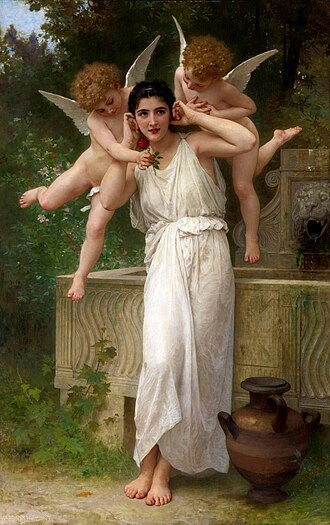
"For not even herein ought such as are married to compare themselves with the deserts of the continent, in that of them virgins are born: for this is not a good of marriage, but of nature: which was so ordered of God, as that of every sexual intercourse whatever of the two sexes of human kind, whether in due order and honest, or base and unlawful, there is born no female save a virgin, yet is none born a sacred virgin: so it is brought to pass that a virgin is born even of fornication, but a sacred virgin not even of marriage."

Virginity is a social construct that denotes the state of a person who has never engaged in sexual intercourse. As it is not an objective term with an operational definition, social definitions of what constitutes virginity, or the lack thereof, vary. Heterosexual individuals may or may not consider loss of virginity to occur only through penile–vaginal penetration, while people of other sexual or
"Narrated Aisha: I asked the Prophet, "O Allahs Messenger! Should the women be asked for their consent to their marriage?" He said, "Yes." I said, "A virgin, if asked, feels shy and keeps quiet." He said, "Her silence means her consent."
"Herein also you ought to recognise the Paraclete in His character of Comforter, in that He excuses your infirmity from (the stringency of) an absolute continence."
"Virginity: you dont get that back, because you were in such a big hurry to get rid of it in the first place."
"If any one saith, that the marriage state is to be placed above the state of virginity, or of celibacy, and that it is not better and more blessed to remain in virginity, or in celibacy, than to be united in matrimony; let him be anathema."
"He has the special quality of virginity, most and least ambiguous of states: ignorance, yet at the same time, power in potentia, and furthermore, unknowingness, which is not the same as ignorance."
"If a man find a damsel that is a virgin, which is not betrothed, and lay hold on her, and lie with her, and they be found; Then the man that lay with her shall give unto the damsels father fifty shekels of silver, and she shall be his wife; because he hath humbled her, he may not put her away all his days."
"[explaining to Ernie how April apologized to him] She just showed up at the factory, took off her coat, and begged me to take her. We made love in a way that Ive only ever seen in nature films."
"All men suppose what is called Wisdom to deal with the first causes and the principles of things; so that, as has been said before, the man of experience is thought to be wiser than the possessors of any sense-perception whatever, the artist wiser than the men of experience, the masterworker than the mechanic, and the theoretical kinds of knowledge to be more of the nature of Wisdom than the productive."
"The yarns of seamen have a direct simplicity, the whole meaning of which lies within the shell of a cracked nut. But Marlow was not typical (if his propensity to spin yarns be excepted), and to him the meaning of an episode was not inside like a kernel but outside, enveloping the tale which brought it out only as a glow brings out a haze, in the likeness of one of these misty halos that sometimes are made visible by the spectral illumination of moonshine."
"Going up that river was like traveling back to the earliest beginnings of the world, when vegetation rioted on the earth and the big trees were kings. An empty stream, a great silence, an impenetrable forest. The air was warm, thick, heavy, sluggish. There was no joy in the brilliance of sunshine. The long stretches of the waterway ran on, deserted, into the gloom of overshadowed distances."
"The intimate rapport with nature is one of the most precious things in life. Nature is indeed very close to us; sometimes closer than hands and feet, of which in truth she is but the extension. The emotional appeal of nature is tremendous, sometimes almost more than one can bear."
"Are people naturally destructive, immoral, predatory and self-seeking, only to be kept in order by harsh laws and fiercely deterrent mandatory sentences? Or are men and women naturally orderly, merciful, humane and bred with a need for justice and mutual aid? Of course these qualities, or defects, are not evenly distributed, and undoubtedly there is much of each in all of us, but when it comes to the law some sort of distinction can be drawn. Are you a Shylock or a Bassanio? Shylock pinned his faith on the words in the contract, the nature of his bond and the duty of the state to uphold the letter of the law regardless of human suffering. Bassanio put another point of view. More important than the sanctity of the law was the plight of the individual parties in the particular case."