Quote
"The proles were immortal, you could not doubt it when you looked at that valiant figure in the yard."
N
Nineteen Eighty-Four"For the first time he perceived that if you want to keep a secret you must also hide it from yourself. You must know all the while that it is there, but until it is needed you must never let it emerge into your consciousness in any shape that could be given a name. From now onwards he must not only think right; he must feel right, dream right. And all the while he must keep his hatred locked up inside him like a ball of matter which was part of himself and yet unconnected with the rest of him, a kind of cyst."
Nineteen Eighty-Four is a dystopian speculative fiction novel by the English writer George Orwell. It was published on 8 June 1949 by Secker & Warburg as Orwell's ninth and final completed book. Thematically, it centres on totalitarianism, mass surveillance and repressive regimentation of people and behaviours. Nineteen Eighty-Four has been often regarded as a classic and has been acknowledged for
"The proles were immortal, you could not doubt it when you looked at that valiant figure in the yard."
"The earth is as old as we are, no older. How could it be older? Nothing exists except through human consciousness."
"The command of the old despotisms was Thou Shalt Not. The command of the totalitarians was Thou Shalt. Our command is Thou Art. No one whom we bring to this place ever stands out against us. Everyone is washed clean."
"Sanity was statistical. It was merely a question of learning to think as they thought."
"Three novels effectively tell the story of Burmas recent history. The link begins with Burmese Days, which chronicles the countrys history under British colonialism. Not long after Burma became independent from Britain in 1948, a military dictator sealed off the country from the outside world, launched The Burmese Way to Socialism, and turned Burma into one of the poorest countries in Asia. The same story is told in Animal Farm. Finally in Nineteen Eighty-Four Orwells description of a horrifying and soulless dystopia paints a chillingly accurate picture of Burma today, a country ruled by one of the worlds most brutal and tenacious dictatorships. In Burma there is a joke that Orwell wrote not just one novel about the country, but three: a trilogy comprised of Burmese Days, Animal Farm and Nineteen Eighty-Four."
"The immediate advantages of falsifying the past were obvious, but the ultimate motive was mysterious."
"In the life of the mass-order, the culture of the generality tends to conform to the demands of the average human being. Spirituality decays through being diffused among the masses when knowledge is impoverished in every possible way by rationalisation until it becomes accessible to the crude understanding of all."
"I say this to you because we Spaniards are a forgetful people, because we are used to living for the moment, because we do not look back, because we do not know how to see the chain of heroes, because we do not contemplate the sum of sacrifices."
 Francisco Franco
"Sharon Tate was my best friend. Once, we were roommates. She introduced me to my husband. She was the godmother to my baby daughter who is named for her. In the six years time that I knew her, she never said an unkind word about anyone."
"Long time to see. (VS: Tapion)"
"Most mathematicians prove what they can, von Neumann proves what he wants." Once in a discussion about the rapid growth of mathematics in modern times, von Neumann was heard to remark that whereas thirty years ago a mathematician could grasp all of mathematics, that is impossible today. Someone asked him: "What percentage of all mathematics might a person aspire to understand today?" Von Neumann went into one of his five-second thinking trances, and said: "About 28 percent."
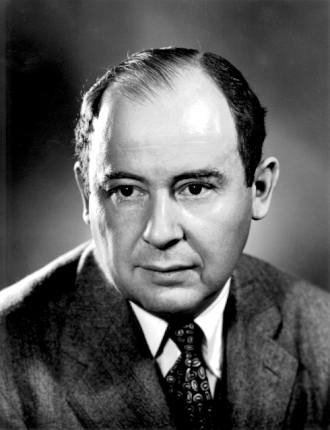 John von Neumann
"Children must be free to think in all directions irrespective of the peculiar ideas of parents who often seal their childrens minds with preconceived prejudices and false concepts of past generations. Unless we are very careful, very careful indeed, and very conscientious, there is still great danger that our children may turn out to be the same kind of people we are."