Quote
"The only method of learning to bear with dignity the vicissitudes of fortune is to recall the catastrophes of others."
P
Polybius"How highly should we honor the Macedonians, who for the greater part of their lives never cease from fighting with the barbarians for the sake of the security of Greece? For who is not aware that Greece would have constantly stood in the greater danger, had we not been fenced by the Macedonians and the honorable ambition of their kings?"
Polybius was an ancient Greek historian of the middle Hellenistic period. He is noted for his Histories, a universal history documenting the rise of Rome in the Mediterranean in the third and second centuries BC. It covers the period 264–146, recording in detail events in Italy, Iberia, Greece, Macedonia, Syria, Egypt, and Africa, and documents the Punic Wars and Macedonian Wars among many others.
"The only method of learning to bear with dignity the vicissitudes of fortune is to recall the catastrophes of others."
"When a state after having passed with safety through many and great dangers arrives at the higher degree of power, and possesses an entire and undisputed sovereignty, it is manifest that the long continuance of prosperity must give birth to costly and luxurious manners, and that the minds of men will be heated with ambitious contests, and become too eager and aspiring in the pursuit of dignities. And as those evils are continually increased, the desire of power and rule, along with the imagined ignominy of remaining in a subject state, will first begin to work the ruin of the republic; arroagance and luxury will afterwards advance it; and in the end the change will be completed by the people; when the avarice of some is found to injure and oppress them, and the ambition of others swells their vanity, and poisons them with flattering hopes. For then, being inflamed with rage, and following only the dictates of their passions, they no longer will submit to any control, or be contented with an equal share of the administration, in conjunction with their rules; but will draw to themselves the entire sovereignty and supreme direction of all affairs. When this is done, the government will assume indeed the fairest of a ll names, that of a free and popular state; but will in truth be the greatest of all evils, the government of the multitude."
"The date from which I propose to begin my history is the 140th Olympiad [220 - 216 B.C.], and the events are the following: (1) in Greece the so‑called Social War, the first waged against the Aetolians by the Achaeans in league with and under the leadership of Philip of Macedon, the son of Demetrius and father of Perseus, (2) in Asia the war for Coele-Syria between Antiochus and Ptolemy Philopator, (3) in Italy, Libya, and the adjacent regions, the war between Rome and Carthage, usually known as the Hannibalic War. These events immediately succeed those related at the end of the work of Aratus of Sicyon. Previously the doings of the world had been, so to say, dispersed, as they were held together by no unity of initiative, results, or locality; but ever since this date history has been an organic whole, and the affairs of Italy and Libya have been interlinked with those of Greece and Asia, all leading up to one end. And this is my reason for beginning their systematic history from that date."
"We can get some idea of a whole from a part, but never knowledge or exact opinion. Special histories therefore contribute very little to the knowledge of the whole and conviction of its truth. It is only indeed by study of the interconnexion of all the particulars, their resemblances and differences, that we are enabled at least to make a general survey, and thus derive both benefit and pleasure from history."
"I observe that while several modern writers deal with particular wars and certain matters connected with them, no one, as far as I am aware, has even attempted to inquire critically when and whence the general and comprehensive scheme of events originated and how it led up to the end. I therefore thought it quite necessary not to leave unnoticed or allow to pass into oblivion this the finest and most beneficent of the performances of Fortune. For though she is ever producing something new and ever playing a part in the lives of men, she has not in a single instance ever accomplished such a work, ever achieved such a triumph, as in our own times. We can no more hope to perceive this from histories dealing with particular events than to get at once a notion of the form of the whole world, its disposition and order, by visiting, each in turn, the most famous cities, or indeed by looking at separate plans of each: a result by no means likely. He indeed who believes that by studying isolated histories he can acquire a fairly just view of history as a whole, is, as it seems to me, much in the case of one, who, after having looked at the dissevered limbs of an animal once alive and beautiful, fancies he has been as good as an eyewitness of the creature itself in all its action and grace."
"In the past you rivalled the Achaians and the Macedonians, peoples of your own race, and Philip, their commander, for the hegemony and glory, but now that the freedom of the Hellenes is at stake at a war against an alien people (Romans), ...And does it worth to ally with the barbarians, to take the field with them against the Epeirotans, the Achaians, the Akarnanians, the Boiotians, the Thessalians, in fact with almost all the Hellenes with the exception of the Aitolians who are a wicked nation... ...So Lakedaimonians it is good to remember your ancestors,... be afraid of the Romans... and do ally yourselves with the Achaians and Macedonians. But if some the most powerful citizens are opposed to this policy at least stay neutral and do not side with the unjust."
"Gentlemen, no fighting please. This is, after all, a council of war. (p. 26)"
 Discworld
"I should say that when people talk about capitalism its a bit of a joke. Theres no such thing. No country, no business class, has ever been willing to subject itself to the free market, free market discipline. Free markets are for others. Like, the Third World is the Third World because they had free markets rammed down their throat. Meanwhile, the enlightened states, England, the United States, others, resorted to massive state intervention to protect private power, and still do. Thats right up to the present. I mean, the Reagan administration for example was the most protectionist in post-war American history. Virtually the entire dynamic economy in the United States is based crucially on state initiative and intervention: computers, the internet, telecommunication, automation, pharmaceutical, you just name it. Run through it, and you find massive ripoffs of the public, meaning, a system in which under one guise or another the public pays the costs and takes the risks, and profit is privatized. Thats very remote from a free market. Free market is like what India had to suffer for a couple hundred years, and most of the rest of the Third World."
"The Dwarf sees farther than the Giant, when he has the Giants shoulders to mount on."
 Samuel Taylor Coleridge
"If civilization has an opposite, it is war."
"A word of the faith that never balks, Here or henceforward it is all the same to me, I accept Time absolutely. It alone is without flaw, it alone rounds and completes all, That mystic baffling wonder alone completes all. (23)"
"I am dominated by one thing, an irresistible, burning attraction towards the abstract. The expression of human feelings and the passions of man certainly interest me deeply, but I am less concerned with expressing the motions of the soul and mind than to render visible, so to speak, the inner flashes of intuition which have something divine in their apparent insignificance and reveal magic, even divine horizons, when they are transposed into the marvellous effects of pure plastic art."
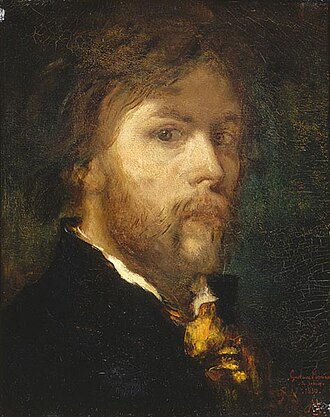 Gustave Moreau