Quote
"In loudest din or hush profound My ears catch evils slightest sound Let those who toll out evils knell Beware my power, the F-Sharp Bell!"
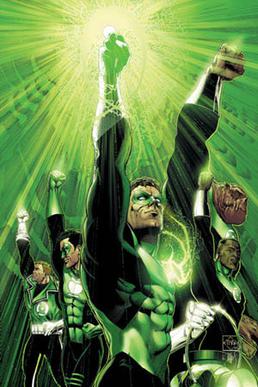 Green Lantern
"I picked out the name from the train man on the tracks who was waving a lantern, going from red to green.... Green meant go and I decided that was it. Then I needed a colorful and interesting costume. I was interested in Greek mythology and so the costume took on elements of that. It just all fell into place. When I sent it in, I waited into the second week before I heard the word to come in. I was ushered into Mr. [[w:Max Gaines|[Max] Gaines]] office, publisher, and after sitting a long time and flipping through the pages of my presentation, he announced, We like it! And then, Get to work! I did the first five pages of an eight page story, and then they called in Bill Finger to help. We worked on it for seven years."
Green Lantern is the name of several superheroes appearing in American comic books published by DC Comics. They fight evil with the aid of rings that grant them a variety of extraordinary powers, all of which come from imagination, fearlessness, and the electromagnetic spectrum of emotional willpower. The characters are typically depicted as members of the Green Lantern Corps, an intergalactic law
"In loudest din or hush profound My ears catch evils slightest sound Let those who toll out evils knell Beware my power, the F-Sharp Bell!"
Green Lantern"I shall shed my light over dark evil. For the dark things cannot stand the light, The light of the Green Lantern!"
Green Lantern"In days of peace, in nights of war Obey the Laws forever more Misconduct must be answered for Swear us the chosen: The Alpha Corps!"
Green Lantern"In brightest day, in blackest night, No evil shall escape my sight Let those who worship evils might, Beware my power...Green Lanterns light!"
Green Lantern"In forest dark or glade beferned, No blade of grass shall go unturned Let those who have the daylight spurned Tread not where this green lamp has burned."
Green Lantern"You who are wicked, evil and mean Im the nastiest creep youve ever seen! Come one, come all, put up a fight Ill pound your butts with Green Lanterns light! Yowza."
Green Lantern"As long as you keep getting born, it’s okay to die sometimes."
"The smart way to keep people passive and obedient is to strictly limit the spectrum of acceptable opinion, but allow very lively debate within that spectrum - even encourage the more critical and dissident views. That gives people the sense that theres free thinking going on, while all the time the presuppositions of the system are being reinforced by the limits put on the range of the debate."
"History is a strange experience. The world is quite small now; but history is large and deep. Sometimes you can go much farther by sitting in your own home and reading a book of history, than by getting onto a ship or an airplane and traveling a thousand miles. When you go to Mexico City through space, you find it a sort of cross between modern Madrid and modern Chicago, with additions of its own; but if you go to Mexico City through history, back only 500 years, you will find it as distant as though it were on another planet: inhabited by cultivated barbarians, sensitive and cruel, highly organized and still in the Copper Age, a collection of startling, of unbelievable contrasts."
"As soon as a thought or word becomes a tool, one can dispense with actually ‘thinking’ it, that is, with going through the logical acts involved in verbal formulation of it. As has been pointed out, often and correctly, the advantage of mathematics—the model of all neo-positivistic thinking—lies in just this ‘intellectual economy.’ Complicated logical operations are carried out without actual performance of the intellectual acts upon which the mathematical and logical symbols are based. … Reason … becomes a fetish, a magic entity that is accepted rather than intellectually experienced."
"Our feminist culture at the present moment is completely dependent on capitalism. My grandmother was still scrubbing clothes on the back porch on a washboard!"
"A word of the faith that never balks, Here or henceforward it is all the same to me, I accept Time absolutely. It alone is without flaw, it alone rounds and completes all, That mystic baffling wonder alone completes all. (23)"