Quote
"Yeah, I dont think you can live anywhere else -- its such a great city [New York]. L.A. is kind of a necessary evil, but man, I love going back to New York."
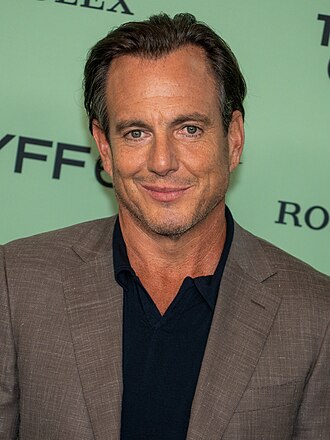 Will Arnett
"I started [acting] when I was a young teenager. My mom encouraged me to go to read for some stuff in Toronto, and I ended up doing a couple of crappy commercials and was like, "Oh, yeah, Id like to do this!" And then kind of put it on the back burner, and then pursued it a little bit when I was in Toronto, like studying a little bit here and there. And I decided to move to New York and go to Lee Strasberg. And I kind of, for the first time ever, really felt like I was doing something that I enjoyed, and that I felt like I could conceivably be good at. And when those two things happen, [ironically] youre off to the races."
William Emerson Arnett is a Canadian and American actor and comedian. He is widely known for his roles as Gob Bluth in the Fox/Netflix sitcom Arrested Development and the titular character in the Netflix animated series BoJack Horseman (2014–2020). He has received nominations for seven Primetime Emmy Awards and three Screen Actors Guild Awards.
"Yeah, I dont think you can live anywhere else -- its such a great city [New York]. L.A. is kind of a necessary evil, but man, I love going back to New York."
Will Arnett"I did terrible little plays in New York that we put up ourselves. My first movie was this independent that I did on the Erie Canal in 1995, called Erie, that I dont know if you could even get, actually with Felicity Huffman. And then from that I did this film that was eventually called The Broken Giant later that fall. And then I kind of started getting into doing pilots."
Will Arnett"The summer of 2000 was a real turning point for me, and I kind of got my act together and laid the bottle down and got to work, and really last five years have been the greatest five years of my life, personally and then -- as a result of that, I guess -- professionally. Six months after that, I met Amy [Poehler]. We had sort of met before, but we started dating. From the moment we met, it was the greatest thing that ever happened to me. It was great. We didnt know what we were doing, and all of a sudden she got SNL, so we kind of decided that I guess I had to move to New York; otherwise it wasnt going to work out. So I moved back to New York and it was the greatest. It was great. Probably the best thing thats ever happened to me is Amy."
Will Arnett"I did The Mike OMalley Show. It aired twice. You know, that was a really tough experience because Mike is a really good friend of mine, and was before that, and we were all friends, everybody on the show. It was Mike, and it was me, and Mikes sister Kerry, and Missy Yager, who I was then dating...well, we had just broken up; we had lived together for four years and we did that. And this guy Mark Rosenthal and Kate Walsh. And we were all friends, and we were all excited at the opportunity to do this show together. We were kind of shocked, and we thought, "God, this is so cool, that the six of us are doing this show!" And then we realized that they never intended to follow it or support us. You know, I think that show got a really bad rap, but by the end -- by the sixth or seventh episode or whatever it was that we made -- we were starting to find a voice on that show, and we were very disappointed. I took the disappointment of that really to heart, and the year after that got cancelled was probably the darkest year of my life. It was tough. It was a really tough time for me. And I didnt get a lot of work. And I didnt do anything, I just kind of drank those years away."
Will Arnett"I guess my first pilot was February of 96. I did a pilot with Kevin Pollak and his wife, Lucy Webb, for CBS, that was not picked up. And then I kind of started being more in the process. I kind of hung around, looking for work. Didnt do a pilot the next year, but in that time did this film called Southie that we shot in south Boston with these guys that I knew. But really was more focused on doing dramatic stuff. And then every year or couple of years doing, you know [with forced cheer] sitcom pilot!"
Will Arnett"The smart way to keep people passive and obedient is to strictly limit the spectrum of acceptable opinion, but allow very lively debate within that spectrum - even encourage the more critical and dissident views. That gives people the sense that theres free thinking going on, while all the time the presuppositions of the system are being reinforced by the limits put on the range of the debate."
"There is no ethical idea which it [dharma] has not stressed, put in its most ideal and imperative form, enforced by teaching, injunction, parable, artistic creation, formative examples. Truth, honour, loyalty, fidelity, courage, chastity, love, long-suffering, self-sacrifice, harmlessness, forgiveness, compassion, benevolence, beneficence are its common themes, are, in its view, the very stuff of a right human life, the essence of mans dharma. Buddhism, with its high and noble ethics, Jainism, with its austere ideal of self-conquest, Hinduism, with its magnificent examples of all sides of the Dharma, are not inferior in ethical teaching and practice to any religion or system, but rather take the highest rank and have had the strongest effective force."
"Moving forward will not be for the faint of heart. But if the next century witnesses failure, let it be because our science is not yet up to the job, not because we dont have the courage to make less random the sometimes most unfair courses of human evolution."
"Our units of temporal measurement, from seconds on up to months, are so complicated, asymmetrical and disjunctive so as to make coherent mental reckoning in time all but impossible. Indeed, had some tyrannical god contrived to enslave our minds to time, to make it all but impossible for us to escape subjection to sodden routines and unpleasant surprises, he could hardly have done better than handing down our present system. It is like a set of trapezoidal building blocks, with no vertical or horizontal surfaces, like a language in which the simplest thought demands ornate constructions, useless particles and lengthy circumlocutions. Unlike the more successful patterns of language and science, which enable us to face experience boldly or at least level-headedly, our system of temporal calculation silently and persistently encourages our terror of time. ... It is as though architects had to measure length in feet, width in meters and height in ells; as though basic instruction manuals demanded a knowledge of five different languages. It is no wonder then that we often look into our own immediate past or future, last Tuesday or a week from Sunday, with feelings of helpless confusion."
"We must present democracy as a force holding within itself the seeds of unlimited progress by the human race. By our actions we should make it clear that such a democracy is a means to a better way of life, together with a better understanding among nations. Tyranny inevitably must retire before the tremendous moral strength of the gospel of freedom and self-respect for the individual, but we have to recognize that these democratic principles do not flourish on empty stomachs, and that people turn to false promises of dictators because they are hopeless and anything promises something better than the miserable existence that they endure. However, material assistance alone is not sufficient. The most important thing for the world today in my opinion is a spiritual regeneration which would reestablish a feeling of good faith among men generally. Discouraged people are in sore need of the inspiration of great principles. Such leadership can be the rallying point against intolerance, against distrust, against that fatal insecurity that leads to war. It is to be hoped that the democratic nations can provide the necessary leadership."
"James Baker was the only leader in America who had the guts to stand up and act against Israels malignant disease: the settlements. When he was the Secretary of State, he simply informed the Israeli government that he would deduct the sums expended on the settlements from the money Israel was getting from the US. Threatened and made good on his threat. Baker thus confronted the "pro-Israeli" lobby in the US, both the Jewish and the Christian. Such courage is rare in the United States, as it is rare in Israel."