Quote
"The trees are dead. The days are an arrow in a dead mans chest."
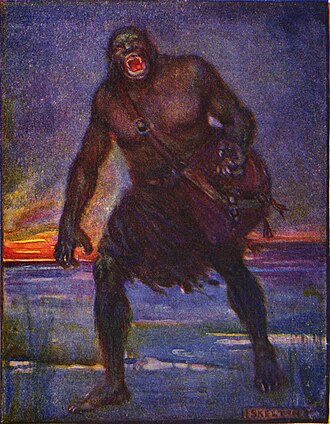 Grendel
"I understood that the world was nothing: a mechanical chaos of casual, brute enmity on which we stupidly impose our hopes and fears. I understood that, finally and absolutely, I alone exist. All the rest, I saw, is merely what pushes me, or what I push against, blindly—as blindly as all that is not myself pushes back."
Grendel is a character in the Anglo-Saxon epic poem Beowulf. He is one of the poem's three antagonists, all aligned in opposition against the protagonist Beowulf. He is referred to as both an eoten and a þyrs, types of beings from wider Germanic mythology. He is also described as a descendant of the Biblical Cain and "a creature of darkness, exiled from happiness and accursed of God, the destroyer
"The trees are dead. The days are an arrow in a dead mans chest."
Grendel"Hey!" he yelled. A forgivable lapse."
Grendel"Pity poor Hrothgar, Grendels foe! Pity poor Grendel, O,O,O!"
Grendel"What was he? The man had changed the world, had torn up the past by its thick, gnarled roots and had transmuted it, and they, who knew the truth, remembered it his way--and so did me"
Grendel"It is I," I say. "The Destroyer."
Grendel"Pity poor Grengar, Hrothdels foe! Down goes the whirlpool: Eek! No, no!"
Grendel"In the life of each of us, I said to myself, there is a place remote and islanded, and given to endless regret or secret happiness."
"Chess for me is not a game, but an art. Yes, and I take upon myself all those responsibilities which an art imposes on its adherents."
"On the platform a group of peasants were standing in military formation five soldiers armed with rifles guarding them. There were men and women, each carrying a bundle. Somehow, lining them up in military formation made the thing grotesque—wretched looking peasants, half-starved, tattered clothes, frightened faces, standing to attention. These may be kulaks, I thought, but if so they have made a mighty poor thing of exploiting their fellows. I hung about looking on curiously, wanting to ask where they were to be sent—to the north to cut timber, somewhere else to dig canals—until one of the guards told me sharply to take myself off."
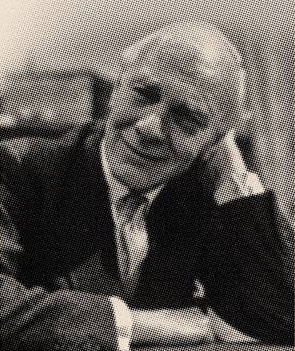 Malcolm Muggeridge
"We foreign journalists in Moscow used to amuse ourselves, as a matter of fact, by competing with one another as to who could wish upon one of these intelligentsia visitors to the USSR the most outrageous fantasy…One story I floated myself, for which I received considerable acclaim, was that the huge queues outside food shops came about because the Soviet workers were so ardent in building Socialism that they just wouldnt rest, and the only way the government could get them to rest for even two or three hours was organizing a queue for them to stand in. I laugh at it all now, but at the time you can imagine what a shock it was to someone like myself, who had been brought up to regard liberal intellectuals as the samurai, the absolute elite, of the human race, to find that they could be taken in by deceptions which a half-witted boy would see through in an instant…I could never henceforth regard the intelligentsia as other than credulous fools who nonetheless became the medias prophetic voices, their heirs and successors remaining so still."
Malcolm Muggeridge"Is he the best in the world? He might not get the attention of (Lionel) Messi and Ronaldo but yes, I think he just might be.If you dont have a player like Steven Gerrard, who is the engine room, it can affect the whole team.When we were winning league titles and European Cups at Real, I always said Claude Makelele was our most important player. There is no way myself, (Luis) Figo or Raul would have been able to do what we did without Claude and the same goes for Liverpool and Gerrard. He has great passing ability, can tackle and scores goals, but most importantly he gives the players around him confidence and belief. You cant learn that -- players like him are just born with that presence."
 Steven Gerrard
"Say anything you want against The Seventh Seal. My fear of death — this infantile fixation of mine — was, at that moment, overwhelming. I felt myself in contact with death day and night, and my fear was tremendous. When I finished the picture, my fear went away. I have the feeling simply of having painted a canvas in an enormous hurry — with enormous pretension but without any arrogance. I said, Here is a painting; take it, please."