SHAWORDS

I will not, from henceforward, talk to any squarer of the circle, tris — Augustus De Morgan

"I will not, from henceforward, talk to any squarer of the circle, trisector of the angle, duplicator of the cube, constructor of perpetual motion, subverter of gravitation, stagnator of the earth, builder of the universe, etc."
A
Augustus De Morgan
Augustus De Morgan
author41 quotes

Augustus De Morgan was a British mathematician and logician. He is best known for De Morgan's laws relating logical conjunction, disjunction, and negation, and for coining the term "mathematical induction", the underlying principles of which he formalized. De Morgan's contributions to logic are heavily used in many branches of mathematics, including set theory and probability theory, as well as ot

More by Augustus De Morgan

View all →
Quote
"My specific... object has been to contain, within the prescribed limits, the whole of the students course, from the confines of elementary algebra and trigonometry, to the entrance of the highest works on mathematical physics. A learner who has a good knowledge of the subjects just named, and who can master the present treatise, taking up elementary works on conic sections, application of algebra to geometry, and the theory of equations, as he wants them, will, I am perfectly sure, find himself able to conquer the difficulties of anything he may meet with; and need not close any book of Laplace, Lagrange, Legendre, Poisson, Fourier, Cauchy, Gauss, Abel, Hindenburgh and his followers. or of any one of our English mathematicians, under the idea that it is too hard for him."
A
Augustus De Morgan
Quote
"Experience has convinced me that the proper way of teaching is to bring together that which is simple from all quarters, and, if I may use such a phrase, to draw upon the surface of the subject a proper mean between the line of closest connexion and the line of easiest deduction. This was the method followed by Euclid, who, fortunately for us, never dreamed of a geometry of triangles, as distinguished from a geometry of circles, or a separate application of the arithmetics of addition and subtraction; but made one help out the other as he best could."
A
Augustus De Morgan
Quote
"The student of the Differential Calculus may... be brought to think it possible that the terms and ideas which that science requires may exist in his own mind in the same rude form as that of a straight line in the conceptions of a beginner in geometry. ...he must be prepared to stop his course until he can form exact notions, acquire precise ideas, both of resemblance between those things which have appeared most distinct, and of distinction between those which have appeared most alike. To do this... formal definitions would be useless; for he cannot be supposed to have one single notion in that precise form which would make it worth while to attach it to a word. One reason of the great difficulty which is found in treatises on this subject... the tacit assumption that nothing is necessary previously to actually embodying the terms and rules of the science, as if mere statement of definitions could give instantaneous power of using terms rightly. We shall here attempt... a wider degree of verbal explanation than is usual with the view of enabling the student to come to the definitions in some state of previous preparation."
A
Augustus De Morgan
Quote
"...nor have I found occasion to depart from the plan... the rejection of the whole doctrine of series in the establishment of the fundamental parts both of the Differential and Integral Calculus. The method of Lagrange... had taken deep root in elementary works; it was the sacrifice of the clear and indubitable principle of limits to a phantom, the idea that an algebra without limits was purer than one in which that notion was introduced. But, independently of the idea of limits being absolutely necessary even to the proper conception of a convergent series, it must have been obvious enough to Lagrange himself, that all application of the science to concrete magnitude, even in his own system, required the theory of limits."
A
Augustus De Morgan
Quote
"The following Treatise... has been endeavoured to make the theory of limits, or ultimate ratios... the sole foundation of the science, without any aid whatsoever from the theory of series, or algebraical expansions. I am not aware that any work exists in which this has been avowedly attempted, and I have been the more encouraged to make the trial from observing that the objections to the theory of limits have usually been founded either upon the difficulty of the notion itself, or its unalgebraical character, and seldom or never upon anything not to be defined or not to be received in the conception of a limit..."
A
Augustus De Morgan

More on War

View all →
Quote
"I should say that when people talk about capitalism its a bit of a joke. Theres no such thing. No country, no business class, has ever been willing to subject itself to the free market, free market discipline. Free markets are for others. Like, the Third World is the Third World because they had free markets rammed down their throat. Meanwhile, the enlightened states, England, the United States, others, resorted to massive state intervention to protect private power, and still do. Thats right up to the present. I mean, the Reagan administration for example was the most protectionist in post-war American history. Virtually the entire dynamic economy in the United States is based crucially on state initiative and intervention: computers, the internet, telecommunication, automation, pharmaceutical, you just name it. Run through it, and you find massive ripoffs of the public, meaning, a system in which under one guise or another the public pays the costs and takes the risks, and profit is privatized. Thats very remote from a free market. Free market is like what India had to suffer for a couple hundred years, and most of the rest of the Third World."
N
Noam Chomsky
Quote
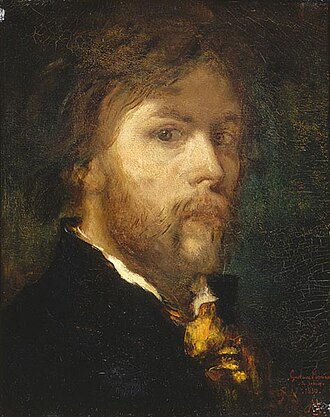
"I am dominated by one thing, an irresistible, burning attraction towards the abstract. The expression of human feelings and the passions of man certainly interest me deeply, but I am less concerned with expressing the motions of the soul and mind than to render visible, so to speak, the inner flashes of intuition which have something divine in their apparent insignificance and reveal magic, even divine horizons, when they are transposed into the marvellous effects of pure plastic art."
Gustave MoreauGustave Moreau