SHAWORDS

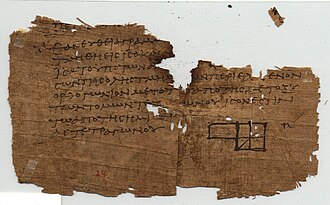
If a straight line [AB] be bisected and a straight line [BD] be added — Euclid’s Elements

"If a straight line [AB] be bisected and a straight line [BD] be added to it in a straight line, the rectangle contained by the whole [AD]... and the added straight line [BD] together with the square on the half [CB] is equal to the square on the straight line [CD] made up of the half and the added straight line. For let a straight line AB be bisected at the point C, and let a straight line BD be added to it in a straight line; I say that the rectangle contained by AD, DB together with the square on CB is equal to the square on CD. For let the square CEFD be described on CD, and let DE be joined; through the point B let BG be drawn parallel to either EC or DF, through the point H let KM be drawn parallel to either AB or EF, and further through A let AK be drawn parallel to either CL or DM. Then, since AC is equal to CB, AL is also equal to CH. But CH is equal to HF. Therefore AL is also equal to HF. Let CM be added to each; therefore the whole AM is equal to the gnomon NOP. But AM is the rectangle AD, DB, for DM is equal to DB; therefore the gnomon NOP is also equal to the rectangle AD, DB. Let LG, which is equal to the square on BC, be added to each; therefore the rectangle contained by AD, DB together with the square on CB is equal to the square on CD."
Euclid’s Elements
Euclid’s Elements
Euclid’s Elements
author

The Elements is a mathematical treatise written c. 300 BC by the Ancient Greek mathematician Euclid.

More by Euclid’s Elements

View all →
Quote
"To cut a given straight line so that the rectangle contained by the whole and one of the segments is equal to the square on the remaining segment. Let AB be the given straight line; thus it is required to cut AB so that the rectangle contained by the whole and one of the segments is equal to the square on the remaining segment. For let the square ABDC be described on AB; let AC be bisected at the point E, and let BE be joined; let CA be drawn through to F, and let EF be made equal to BE; let the square FH be described on AF, and let GH be drawn through to K. I say that AB has been cut at H so as to make the rectangle contained by AB, BH equal to the square on AH. For, since the straight line AC has been bisected at E, and FA is added to it, the rectangle contained by CF, FA together with the square on AE is equal to the square on EF. [Bk II. Prop 6] But EF is equal to EB; therefore the rectangle CF, FA together with the square on AE is equal to the square on EB. But the squares on BA, AE are equal to the square on EB, for the angle at A is right [Bk I. Prop 47, Pythagorean theorem]; therefore the rectangle CF, FA together with the square on AE is equal to the squares on BA, AE. Let the square on AE be subtracted from each; therefore the rectangle CF, FA which remains is equal to the square on AB. Now the rectangle CF, FA is FK, for AF is equal to FG; and the square on AB is AD; therefore FK is equal to AD. Let AK be subtracted from each; therefore FH which remains is equal to HD. And HD is the rectangle AB, BH for AB is equal to BD; and FH is the square on AH; therefore the rectangle contained by AB, BH is equal to the square on HA. therefore the given straight line AB has been cut at H so as to make the rectangle contained by AB, BH equal to the square on HA."
Euclid’s ElementsEuclid’s Elements
Quote
"To suppose that so perfect a system as that of Euclid’s Elements was produced by one man, without any preceding model or materials, would be to suppose that Euclid was more than man. We ascribe to him as much as the weakness of human understanding will permit, if we suppose that the inventions in geometry, which had been made in a tract of preceding ages, were by him not only carried much further, but digested into so admirable a system, that his work obscured all that went before it, and made them be forgot and lost."
Euclid’s ElementsEuclid’s Elements