SHAWORDS

If honor were profitable, everybody would be honorable. — Thomas More

HomeThomas MoreQuote
"If honor were profitable, everybody would be honorable."
Thomas More
Thomas More
Thomas More
author26 quotes

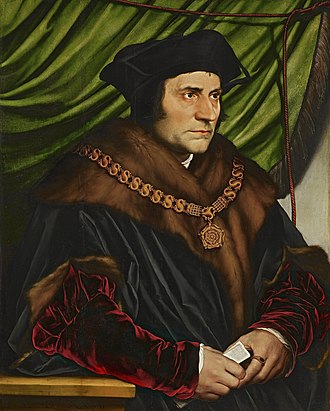
Sir Thomas More, venerated in the Catholic Church as a martyr and saint, was an English lawyer, judge, social philosopher, author, statesman, theologian and noted Renaissance humanist. He also served Henry VIII as Lord Chancellor from October 1529 to May 1532. He wrote Utopia, published in 1516, which describes the political system of an imaginary island state.

More by Thomas More

View all →
Quote
"The island of Utopia is in the middle two hundred miles broad, and holds almost at the same breadth over a great part of it, but it grows narrower towards both ends. Its figure is not unlike a crescent. Between its horns the sea comes in eleven miles broad, and spreads itself into a great bay, which is environed with land to the compass of about five hundred miles, and is well secured from winds. In this bay there is no great current; the whole coast is, as it were, one continued harbour, which gives all that live in the island great convenience for mutual commerce. But the entry into the bay, occasioned by rocks on the one hand and shallows on the other, is very dangerous. In the middle of it there is one single rock which appears above water, and may, therefore, easily be avoided; and on the top of it there is a tower, in which a garrison is kept; the other rocks lie under water, and are very dangerous. The channel is known only to the natives; so that if any stranger should enter into the bay without one of their pilots he would run great danger of shipwreck."
Thomas MoreThomas More
Quote
"They have no lawyers among them, for they consider them as a sort of people whose profession it is to disguise matters and to wrest the laws, and, therefore, they think it is much better that every man should plead his own cause, and trust it to the judge, as in other places the client trusts it to a counsellor; by this means they both cut off many delays and find out truth more certainly; for after the parties have laid open the merits of the cause, without those artifices which lawyers are apt to suggest, the judge examines the whole matter, and supports the simplicity of such well-meaning persons, whom otherwise crafty men would be sure to run down; and thus they avoid those evils which appear very remarkably among all those nations that labour under a vast load of laws. Every one of them is skilled in their law; for, as it is a very short study, so the plainest meaning of which words are capable is always the sense of their laws; and they argue thus: all laws are promulgated for this end, that every man may know his duty; and, therefore, the plainest and most obvious sense of the words is that which ought to be put upon them, since a more refined exposition cannot be easily comprehended, and would only serve to make the laws become useless to the greater part of mankind, and especially to those who need most the direction of them; for it is all one not to make a law at all or to couch it in such terms that, without a quick apprehension and much study, a man cannot find out the true meaning of it, since the generality of mankind are both so dull, and so much employed in their several trades, that they have neither the leisure nor the capacity requisite for such an inquiry."
Thomas MoreThomas More
Quote
"I think putting thieves to death is not lawful; and it is plain and obvious that it is absurd and of ill consequence to the commonwealth that a thief and a murderer should be equally punished; for if a robber sees that his danger is the same if he is convicted of theft as if he were guilty of murder, this will naturally incite him to kill the person whom otherwise he would only have robbed; since, if the punishment is the same, there is more security, and less danger of discovery, when he that can best make it is put out of the way; so that terrifying thieves too much provokes them to cruelty."
Thomas MoreThomas More