SHAWORDS

Increasingly in our time — this is an inevitable result of collectiviz — Rollo May

HomeRollo MayQuote
"Increasingly in our time — this is an inevitable result of collectivization — it is the organization man who succeeds. And he is characterized by the fact that he has significance only if he gives up his significance."
R
Rollo May
Rollo May
author112 quotes

Rollo Reece May was an American existential psychologist and author of the influential book Love and Will (1969). He is often associated with humanistic psychology and existentialist philosophy, and alongside Viktor Frankl, was a major proponent of existential psychotherapy. The philosopher and theologian Paul Tillich was a close friend who had a significant influence on his work.

More by Rollo May

View all →
Quote
"My fellow liberals and I in America, and in Europe to a lesser extent, believed so strongly in peace and world brotherhood in those days that we could not even see Hitler or the destructively daimonic reality he represented. Human beings just couldnt be that cruel in the our civilized twentieth century — the accounts in the papers must be wrong. Our error was that we let our convictions limit our perceptions. We had no place for the daimonic; we believed that the world must somehow fit our convictions, and the whole daimonic dimension was ruled out of our perception. Not to recognize the daimonic itself turns out to be daimonic, it makes us accomplices on the side of the destructive possession. The denial of the daimonic is, in effect, a self-castration in love and a self-nullification in will. And the denial leads to the perverted forms of aggression we have seen in our day in which the repressed comes back to haunt us."
R
Rollo May
Quote
"In any age courage is the simple virtue needed for a human being to traverse the rocky road from infancy to maturity of personality. But in an age of anxiety, an age of her morality and personal isolation, courage is a sine qua non. In periods when the mores of the society were more consistent guides, the individual was more firmly cushioned in his crises of development; but in times of transition like ours, the individual is thrown on his own at an earlier age and for a longer period."
R
Rollo May
Quote
"I must make the important distinction between the rebel and the revolutionary. One is in ineradicable opposition to the other. The revolutionary seeks an external political change, "the overthrow or renunciation of one government or ruler and the substitution of another." The origin of the term is the word revolve, literally meaning a turnover, as the revolution of a wheel. When the conditions under a given government are insufferable some groups may seek to break down that government in the conviction that any new form cannot but be better. Many revolutions, however, simply substitute one kind of government for another, the second no better than the first — which leaves the individual citizen, who has had to endure the inevitable anarchy between the two, worse off than before. Revolution may do more harm than good. The rebel, on the other hand, is "one who opposes authority or restraint: one who breaks with established custom or tradition." … He seeks above all an internal change, a change in the attitudes, emotions, and outlook of the people to whom he is devoted. He often seems to be temperamentally unable to accept success and the ease it brings; he kicks against the pricks, and when one frontier is conquered, he soon becomes ill-at-ease and pushes on to the new frontier. He is drawn to the unquiet minds and spirits, for he shares their everlasting inability to accept stultifying control. He may, as Socrates did, refer to himself as the gadfly for the state — the one who keeps the state from settling down into a complacency, which is the first step toward decadance. No matter how much the rebel gives the appearance of being egocentric or of being on an "ego trip," this is a delusion; inwardly the authentic rebel is anything but brash."
R
Rollo May

More on Time

View all →
Quote
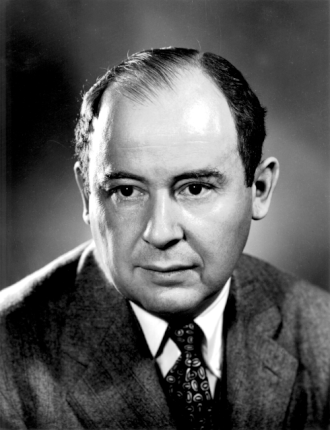
"Most mathematicians prove what they can, von Neumann proves what he wants." Once in a discussion about the rapid growth of mathematics in modern times, von Neumann was heard to remark that whereas thirty years ago a mathematician could grasp all of mathematics, that is impossible today. Someone asked him: "What percentage of all mathematics might a person aspire to understand today?" Von Neumann went into one of his five-second thinking trances, and said: "About 28 percent."
John von NeumannJohn von Neumann