SHAWORDS

It was only the third new set of planetary tables in European history. — Johannes Kepler

"It was only the third new set of planetary tables in European history. And whereas Copernicuss and Ptolemys tables were more or less equally accurate, Keplers were some 50 times more so. Within a few years, it was possible to pinpoint the time of transit of Mercury across the face of the sun so that it was possible to observe it in transit for the first time in human history. Of course, Keplers theories were more difficult, especially since he had incorporated logarithms, which had only been invented a few years earlier. Much of the book, therefore, was made up of explanatory text that told the reader how to use the tables. ...The printing ...was finished on time in September 1627 ...but he was not optimistic ...noting, "There will be few purchasers, as is always the case with mathematical works, especially in the present chaos."
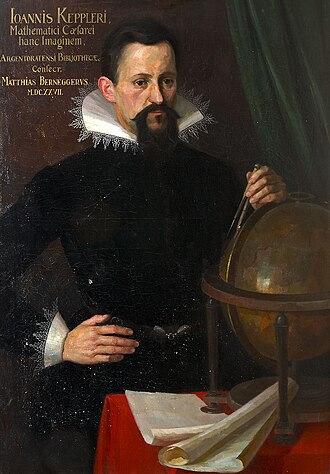
Johannes Kepler
Johannes Kepler
Johannes Kepler
author90 quotes

Johannes Kepler was a German polymath who was an astronomer, mathematician, astrologer, natural philosopher and music theorist. He is a key figure in the 17th-century Scientific Revolution, best known for his laws of planetary motion, and his books Astronomia nova, Harmonice Mundi, and Epitome Astronomiae Copernicanae. The variety and impact of his work made Kepler one of the founders and fathers

More on Time

View all →
Quote
"History is a strange experience. The world is quite small now; but history is large and deep. Sometimes you can go much farther by sitting in your own home and reading a book of history, than by getting onto a ship or an airplane and traveling a thousand miles. When you go to Mexico City through space, you find it a sort of cross between modern Madrid and modern Chicago, with additions of its own; but if you go to Mexico City through history, back only 500 years, you will find it as distant as though it were on another planet: inhabited by cultivated barbarians, sensitive and cruel, highly organized and still in the Copper Age, a collection of startling, of unbelievable contrasts."
G
Gilbert Highet
Quote
"As soon as a thought or word becomes a tool, one can dispense with actually ‘thinking’ it, that is, with going through the logical acts involved in verbal formulation of it. As has been pointed out, often and correctly, the advantage of mathematics—the model of all neo-positivistic thinking—lies in just this ‘intellectual economy.’ Complicated logical operations are carried out without actual performance of the intellectual acts upon which the mathematical and logical symbols are based. … Reason … becomes a fetish, a magic entity that is accepted rather than intellectually experienced."
M
Mathematics