SHAWORDS

It will not be sufficient to know that the enemy has only fifty possib — John von Neumann

"It will not be sufficient to know that the enemy has only fifty possible tricks and that we can counter every one of them, but we must be able to counter them almost at the very instant they occur."
John von Neumann
John von Neumann
John von Neumann
author292 quotes

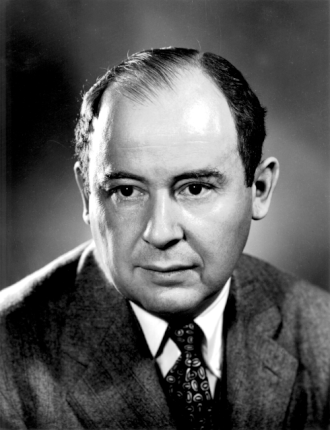
John von Neumann was a Hungarian and American mathematician, physicist, computer scientist and engineer. Von Neumann had perhaps the widest coverage of any mathematician of his time, integrating pure and applied sciences and making major contributions to many fields, including mathematics, physics, economics, computing, and statistics. He was a pioneer in building the mathematical framework of qua

More by John von Neumann

View all →
Quote
"The total subject of mathematics is clearly too broad for any one of us. I do not think that any mathematician since Gauss has covered it fully and uniformly, even Hilbert did not, and all of us are of considerably lesser width (quite apart from the question of depth) than Hilbert. It would therefore, be quite unrealistic not to admit, that any address I could possibly give would not be biased towards some areas in mathematics in which I have had some experience, to the detriment of others which may be equally or more important. To be specific, I could not avoid a bias towards those parts of analysis, logics, and certain border areas of the applications of mathematics to other sciences in which I have worked. If your Committee feels that an address which is affected by such imperfections still fits into the program of the Congress, and if the very generous confidence in my ability to deliver continues, I shall be glad to undertake it."
John von NeumannJohn von Neumann
Quote
"He stimulated people everywhere. Von Neumann was generous intellectually, because his resources were so enormous, that he never gave away anything that he couldnt do without. He was a fountainhead of information, and he didnt hold back because there was always much more in depth than he ever exposed at one time. Im not exaggerating. This was indeed how he was. In the few decades that followed, I have had the experience of understanding what this was like, by working as a consultant for some groups who were at a technical level so far below what I knew myself, that what they felt was worth bickering about was in fact possible [?] that one could ignore it, because one knows one has much more in depth than that and thats not an important point. Let them bicker about it, or let them think that they did something great. He was precisely that way. He was in depth, more knowledgeable than any man, and I say this having worked with Wiener for four years, and Wiener was no slouch himself. Von Neumann was a giant. He was ahead of anybody."
John von NeumannJohn von Neumann
Quote
"Von Neumann had a phenomenal capacity for doing mental computations of all kinds. His thought processes were extremely fast, and often he would see through to the end of someone’s argument almost before the speaker had got out the first few sentences. Recently, one of von Neumann’s colleagues said in affectionate explanation of von Neumann’s power, “You see, Johnny wasn’t human. But after living with humans for so long he learned how to do a remarkable imitation of one.”"
John von NeumannJohn von Neumann
Quote
"At the age of 6 he was able to divide two eight-digit numbers in his head. By the age of 8 he had mastered college calculus and as a trick could memorize on sight a column in a telephone book and repeat back the names, addresses and numbers. History was only a “hobby,” but by the outbreak of World War I, when he was 10, his photographic mind had absorbed most of the contents of the 46-volume works edited by the German historian Oncken with a sophistication that startled his elders."
John von NeumannJohn von Neumann

More on Time

View all →
Quote
"History is a strange experience. The world is quite small now; but history is large and deep. Sometimes you can go much farther by sitting in your own home and reading a book of history, than by getting onto a ship or an airplane and traveling a thousand miles. When you go to Mexico City through space, you find it a sort of cross between modern Madrid and modern Chicago, with additions of its own; but if you go to Mexico City through history, back only 500 years, you will find it as distant as though it were on another planet: inhabited by cultivated barbarians, sensitive and cruel, highly organized and still in the Copper Age, a collection of startling, of unbelievable contrasts."
G
Gilbert Highet
Quote
"As soon as a thought or word becomes a tool, one can dispense with actually ‘thinking’ it, that is, with going through the logical acts involved in verbal formulation of it. As has been pointed out, often and correctly, the advantage of mathematics—the model of all neo-positivistic thinking—lies in just this ‘intellectual economy.’ Complicated logical operations are carried out without actual performance of the intellectual acts upon which the mathematical and logical symbols are based. … Reason … becomes a fetish, a magic entity that is accepted rather than intellectually experienced."
M
Mathematics