SHAWORDS

Man has no greater enemy than himself. I have acted contrary to my sen — Petrarch

HomePetrarchQuote
"Man has no greater enemy than himself. I have acted contrary to my sentiments and inclination; throughout our whole lives we do what we never intended, and what we proposed to do, we leave undone."
Petrarch
Petrarch
Petrarch
author75 quotes

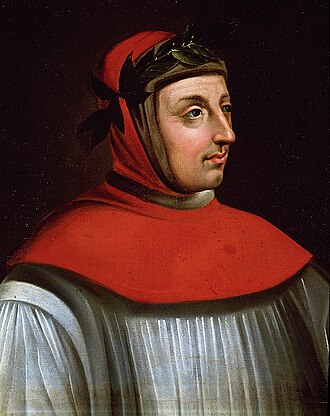
Francis Petrarch was an Italian scholar and poet of the early Italian Renaissance, as well as one of the earliest humanists.

More by Petrarch

View all →
Quote
"To-day I made the ascent of the highest mountain in this region, which is not improperly called Ventosum. My only motive was the wish to see what so great an elevation had to offer. I have had the expedition in mind for many years; for, as you know, I have lived in this region from infancy, having been cast here by that fate which determines the affairs of men. Consequently the mountain, which is visible from a great distance, was ever before my eyes, and I conceived the plan of some time doing what I have at last accomplished to-day."
PetrarchPetrarch
Quote
"My brother, waiting to hear something of St. Augustines from my lips, stood attentively by. I call him, and God too, to witness that where I first fixed my eyes it was written: "And men go about to wonder at the heights of the mountains, and the mighty waves of the sea, and the wide sweep of rivers, and the circuit of the ocean, and the revolution of the stars, but themselves they consider not." I was abashed, and, asking my brother (who was anxious to hear more), not to annoy me, I closed the book, angry with myself that I should still be admiring earthly things who might long ago have learned from even the pagan philosophers that nothing is wonderful but the soul, which, when great itself, finds nothing great outside itself. Then, in truth, I was satisfied that I had seen enough of the mountain; I turned my inward eye upon myself, and from that time not a syllable fell from my lips until we reached the bottom again. Those words had given me occupation enough, for I could not believe that it was by a mere accident that I happened upon them. What I had there read I believed to be addressed to me and to no other, remembering that St. Augustine had once suspected the same thing in his own case, when, on opening the book of the Apostle, as he himself tells us, the first words that he saw there were, "Not in rioting and drunkenness, not in chambering and wantonness, not in strife and envying. But put ye on the Lord Jesus Christ, and make not provision for the flesh, to fulfil the lusts thereof."
PetrarchPetrarch

More on Time

View all →
Quote
"History is a strange experience. The world is quite small now; but history is large and deep. Sometimes you can go much farther by sitting in your own home and reading a book of history, than by getting onto a ship or an airplane and traveling a thousand miles. When you go to Mexico City through space, you find it a sort of cross between modern Madrid and modern Chicago, with additions of its own; but if you go to Mexico City through history, back only 500 years, you will find it as distant as though it were on another planet: inhabited by cultivated barbarians, sensitive and cruel, highly organized and still in the Copper Age, a collection of startling, of unbelievable contrasts."
G
Gilbert Highet
Quote
"As soon as a thought or word becomes a tool, one can dispense with actually ‘thinking’ it, that is, with going through the logical acts involved in verbal formulation of it. As has been pointed out, often and correctly, the advantage of mathematics—the model of all neo-positivistic thinking—lies in just this ‘intellectual economy.’ Complicated logical operations are carried out without actual performance of the intellectual acts upon which the mathematical and logical symbols are based. … Reason … becomes a fetish, a magic entity that is accepted rather than intellectually experienced."
M
Mathematics