Quote
"This maayaa, that is to say, the ego, is like a cloud The sun cannot be seen on account of a thin patch of cloud; when that disappears one sees the sun If by the grace of the guru ones ego vanishes, then one sees God"
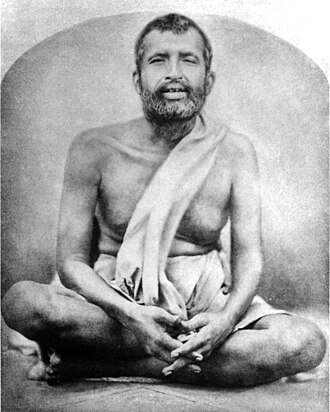 Ramakrishna
"Many people think they cannot have knowledge or understanding of God without reading books. But hearing is better than reading, and seeing is better than hearing. Hearing about Benares is different from reading about it; but seeing Benares is different from either hearing or reading."
Ramakrishna, also called Ramakrishna Paramahamsa, born Ramakrishna Chattopadhyay, was an Indian Hindu mystic. He was a devotee of the goddess Kali, but adhered to various religious practices from the Hindu traditions of Vaishnavism, Tantric Shaktism, and Advaita Vedanta, as well as Christianity and Sufi Islam. His parable-based teachings advocated the essential unity of religions and proclaimed th
"This maayaa, that is to say, the ego, is like a cloud The sun cannot be seen on account of a thin patch of cloud; when that disappears one sees the sun If by the grace of the guru ones ego vanishes, then one sees God"
Ramakrishna"Man cannot really help the world. God alone does that — He who has created the sun and the moon, who has put love for their children in parents hearts, endowed noble souls with compassion, and holy men and devotees with divine love. The man who works for others, without any selfish motive, really does good to himself. There is gold buried in your heart, but you are not yet aware of it. It is covered with a thin layer of earth. Once you are aware of it, all these activities of yours will lessen. … Through selfless work, love of God grows in the heart. Then, through His grace, one realizes Him in course of time. God can be seen, one can talk to Him, as I am talking to you."
Ramakrishna"Many are the names of God, and infinite the forms that lead us to know Him. In whatsoever name or form you desire to call Him, in that very form and name you will see Him."
Ramakrishna"Knowledge leads to unity, but Ignorance to diversity. So long as God seems to be outside and far away, there is ignorance. But when God is realised within, that is true knowledge."
Ramakrishna"God laughs on two occasions. He laughs when the physician says to the patients mother, "Dont be afraid, mother; I shall certainly cure your boy." God laughs, saying to Himself, "I am going to take his life, and this man says he will save it!" The physician thinks he is the master, forgetting that God is the Master. God laughs again when two brothers divide their land with a string, saying to each other, "This side is mine and that side is yours." He laughs and says to Himself, "The whole universe belongs to Me, but they say they own this portion or that portion."
Ramakrishna"He who is called Brahman by the jnanis is known as Atman by the yogis and as Bhagavan by the bhaktas. The same brahmin is called priest, when worshipping in the temple, and cook, when preparing a meal in the kitchen. The jnani, following the path of knowledge, always reason about the Reality saying, "not this, not this." Brahman is neither "this" nor "that"; It is neither the universe nor its living beings. Reasoning in this way, the mind becomes steady. Finally it disappears and the aspirant goes into samadhi. This is the Knowledge of Brahman. It is the unwavering conviction of the jnani that Brahman alone is real and the world is illusory. All these names and forms are illusory, like a dream. What Brahman is cannot be described. One cannot even say that Brahman is a Person. This is the opinion of the jnanis, the followers of Vedanta. But the bhaktas accept all the states of consciousness. They take the waking state to be real also. They dont think the world to be illusory, like a dream. They say that the universe is a manifestation of the Gods power and glory. God has created all these — sky, stars, moon, sun, mountains, ocean, men, animals. They constitute His glory."
Ramakrishna"The wound is the place where the Light enters you."
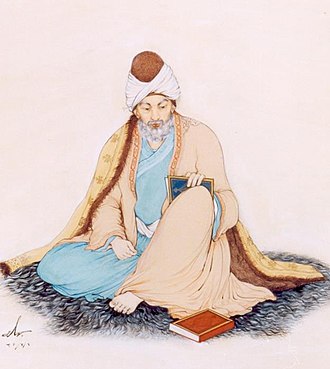 Rumi
Rumi"Be the change that you wish to see in the world."
 Mahatma Gandhi
"In philosophy equally as in poetry it is the highest and most useful prerogative of genius to produce the strongest impressions of novelty, while it rescues admitted truths from the neglect caused by the very circumstance of their universal admission."
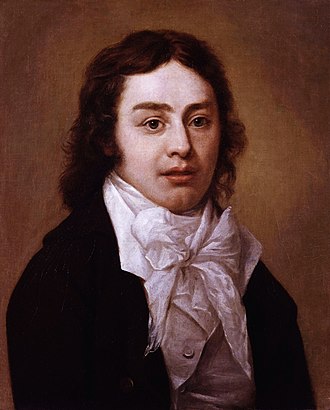 Samuel Taylor Coleridge
"An [hypertext] encyclopaedia will be an overall attempt by the knowledgeable, the learned societies or anyone else, to represent the state-of-the-art in their field. An encyclopaedia will be a living document, as up to date as it can be, instantly accessible at any time. It will contain carefully authored explanations and summaries of the subject, as well as computer-generated indexes of literature. A reference to a paper from the encyclopaedia conveys authority and acceptance by academic society. A measure of a paper’s standing may be conveyed by the number of links it is away from an encyclopaedia."
 Tim Berners-Lee
"The British intellectual tradition is empirical and liberal, the French is rationalist and aristocratic, and the German is idealist and conservative. ...In the great ontological debate between mind and matter, German philosophy comes down solidly on the side of mind. Its emphasis is intuition as opposed to reason, ideas as opposed to facts."
"To know the mighty works of God, to comprehend His wisdom and majesty and power; to appreciate, in degree, the wonderful workings of His laws, surely all this must be a pleasing and acceptable mode of worship to the Most High, to whom ignorance cannot be more grateful than knowledge."