SHAWORDS

Men often oppose a thing, merely because they have had no agency in pl — Alexander Hamilton

"Men often oppose a thing, merely because they have had no agency in planning it, or because it may have been planned by those whom they dislike. But if they have been consulted, and have happened to disapprove, opposition then becomes, in their estimation, an indispensable duty of self-love. They seem to think themselves bound in honor, and by all the motives of personal infallibility, to defeat the success of what has been resolved upon contrary to their sentiments. Men of upright, benevolent tempers have too many opportunities of remarking, with horror, to what desperate lengths this disposition is sometimes carried, and how often the great interests of society are sacrificed to the vanity, to the conceit, and to the obstinacy of individuals, who have credit enough to make their passions and their caprices interesting to mankind. Perhaps the question now before the public may, in its consequences, afford melancholy proofs of the effects of this despicable frailty, or rather detestable vice, in the human character."
Alexander Hamilton
Alexander Hamilton
Alexander Hamilton
author99 quotes

Alexander Hamilton was an American military officer, statesman, and Founding Father who served as the first U.S. secretary of the treasury from 1789 to 1795 under the presidency of George Washington. He also founded America's first political party, the Federalist Party, in 1791.

More by Alexander Hamilton

View all →
Quote
"It was the tendency to infidelity he saw so rife that led him often to declare in the social circle his estimate of Christian truth. “I have examined carefully,” he said to a friend from his boyhood, “the evidence of the Christian religion; and, if I was sitting as a juror upon its authenticity, I should unhesitatingly give my verdict in its favor.” To another person, he observed, “I have studied it, and I can prove its truth as clearly as any proposition ever submitted to the mind of man.”"
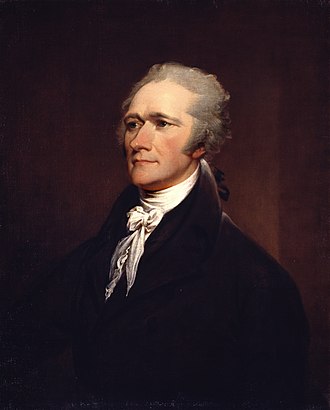
Alexander HamiltonAlexander Hamilton
Quote
"One gentleman, whose name I never heard, was an earnest “friend of the people,” and descanted with much enthusiasm upon the glorious future then opening upon this new-born nation, and predicted the perpetuity of our institutions, from the purity and intelligence of the people, their freedom from interest or prejudice, their enlightened love of liberty, &c, &c. Alexander Hamilton was among the guests; and, his patience being somewhat exhausted, he replied with much emphasis, striking his hand upon the table, “Your people, sir,—your people is a great beast!” I have this anecdote from a friend, to whom it was related by one who was a guest at the table. After-dinner utterances have little value, unless, perhaps, their very levity makes them good indicators of the wind. We do not know the qualifying words which may have followed, or the tone and manner of that which was, perhaps, in part or in the whole, a jest."
Alexander HamiltonAlexander Hamilton

More on Love

View all →
Quote
"At one point a heated discussion arose over the possible interpretation of Lolita as a grandiose metaphor of the classic Europeans hopeless love for young, seductive, barbaric America. In his afterword to the novel Nabokov himself mentions this as the naive theory of one of the publishers who turned the book down. And although there cant be the slightest doubt that Nabokov did not mean to limit Lolita to that interpretation, there is no reason to exclude it as one of the novels many dimensions. The point, I felt, became obvious when one drew the line between Lolita as a delightfully frivolous story on the verge of pornography and Lolita as a literary masterpiece, the only convincing love story of our century."
LolitaLolita
Quote
"He was obeyed, yet he inspired neither love nor fear, nor even respect. He inspired uneasiness. That was it! Uneasiness. Not a definite mistrust — just uneasiness — nothing more. You have no idea how effective such a... a... faculty can be. He had no genius for organizing, for initiative, or for order even. That was evident in such things as the deplorable state of the station. He had no learning, and no intelligence. His position had come to him — why? Perhaps because he was never ill . . . He had served three terms of three years out there . . . Because triumphant health in the general rout of constitutions is a kind of power in itself."
H
Heart of Darkness