Quote
"While it is possible to imagine Mises without Hayek, it is not possible to imagine Hayek without Mises."
L
Ludwig von Mises"Now it cannot be denied that the only way one can offer effective resistance to violent assaults is by violence. Against the weapons of the Bolsheviks, weapons must be used in reprisal, and it would be a mistake to display weakness before murderers. No liberal has ever called this into question. What distinguishes liberal from Fascist political tactics is not a difference of opinion in regard to the necessity of using armed force to resist armed attackers, but a difference in the fundamental estimation of the role of violence in a struggle for power. The great danger threatening domestic policy from the side of Fascism lies in its complete faith in the decisive power of violence. In order to assure success, one must be imbued with the will to victory and always proceed violently. This is its highest principle. What happens, however, when ones opponent, similarly animated by the will to be victorious, acts just as violently? The result must be a battle, a civil war. The ultimate victor to emerge from such conflicts will be the faction strongest in number. In the long run, a minority — even if it is composed of the most capable and energetic — cannot succeed in resisting the majority. The decisive question, therefore, always remains: How does one obtain a majority for ones own party? This, however, is a purely intellectual matter. It is a victory that can be won only with the weapons of the intellect, never by force. The suppression of all opposition by sheer violence is a most unsuitable way to win adherents to ones cause. Resort to naked force — that is, without justification in terms of intellectual arguments accepted by public opinion — merely gains new friends for those whom one is thereby trying to combat. In a battle between force and an idea, the latter always prevails."
Ludwig Heinrich Edler von Mises was an Austrian and American political economist and philosopher of the Austrian school. Mises wrote and lectured extensively on the social contributions of classical liberalism and the central role of consumers in a market economy. He is best known for his work in praxeology, particularly for studies comparing communism and capitalism, as well as for being a defend
"While it is possible to imagine Mises without Hayek, it is not possible to imagine Hayek without Mises."
"Whatever people do in the market economy, is the execution of their own plans. In this sense every human action means planning. What those calling themselves planners advocate is not the substitution of planned action for letting things go. It is the substitution of the planners own plan for the plans of his fellow-men. The planner is a potential dictator who wants to deprive all other people of the power to plan and act according to their own plans. He aims at one thing only: the exclusive absolute pre-eminence of his own plan."
"The characteristic mark of this age of dictators, wars and revolutions is its anti-capitalistic bias. Most governments and political parties are eager to restrict the sphere of private initiative and free enterprise. It is an almost unchallenged dogma that capitalism is done for and that the coming of all-round regimentation of economic activities is both inescapable and highly desirable."
"The interventionists do not approach the study of economic matters with scientific disinterestedness. Most of them are driven by an envious resentment against those whose incomes are larger than their own. This bias makes it impossible for them to see things as they really are. For them the main thing is not to improve the conditions of the masses, but to harm the entrepreneurs and capitalists even if this policy victimizes the immense majority of the people."
"Professor von Mises has a splendid analytical mind and an admirable passion for liberty; but as a student of human nature he is worse than null and as a debater he is of Hyde Park standard."
"The goal of liberalism is the peaceful cooperation of all men. It aims at peace among nations too. When there is private ownership of the means of production everywhere and when laws, the tribunals and the administration treat foreigners and citizens on equal terms, it is of little importance where a countrys frontiers are drawn. Nobody can derive any profit from conquest, but many can suffer losses from fighting. War no longer pays; there is no motive for aggression. The population of every territory is free to determine to which state it wishes to belong, or whether it prefers to establish a state of its own. All nations can coexist peacefully, because no nation is concerned about the size of its state."
"In the life of the mass-order, the culture of the generality tends to conform to the demands of the average human being. Spirituality decays through being diffused among the masses when knowledge is impoverished in every possible way by rationalisation until it becomes accessible to the crude understanding of all."
"I say this to you because we Spaniards are a forgetful people, because we are used to living for the moment, because we do not look back, because we do not know how to see the chain of heroes, because we do not contemplate the sum of sacrifices."
 Francisco Franco
"Sharon Tate was my best friend. Once, we were roommates. She introduced me to my husband. She was the godmother to my baby daughter who is named for her. In the six years time that I knew her, she never said an unkind word about anyone."
"Long time to see. (VS: Tapion)"
"Most mathematicians prove what they can, von Neumann proves what he wants." Once in a discussion about the rapid growth of mathematics in modern times, von Neumann was heard to remark that whereas thirty years ago a mathematician could grasp all of mathematics, that is impossible today. Someone asked him: "What percentage of all mathematics might a person aspire to understand today?" Von Neumann went into one of his five-second thinking trances, and said: "About 28 percent."
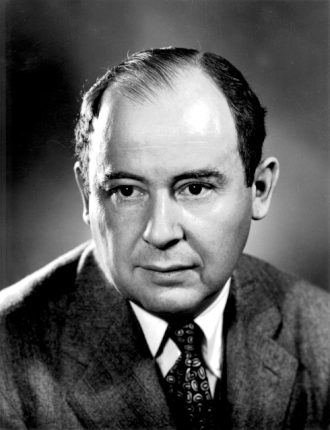 John von Neumann
"Children must be free to think in all directions irrespective of the peculiar ideas of parents who often seal their childrens minds with preconceived prejudices and false concepts of past generations. Unless we are very careful, very careful indeed, and very conscientious, there is still great danger that our children may turn out to be the same kind of people we are."