Quote
"The surest cure for vanity is loneliness."
T
Thomas Wolfe"Now they saw it — its newness, its raw crudeness, and its strength — and turned their shuddering eyes away. "Give us back our well-worn husk," they said, "where we were so snug and comfortable." And then they tried word magic. "Conditions are fundamentally sound," they said — by which they meant to reassure themselves that nothing now was really changed, that things were as they always had been, and as they always would be, forever and ever, amen. But they were wrong. They did not know that you cant go home again. America had come to the end of something and to the beginning of something else. But no one knew what that something else would be and out of the change and uncertainly and the wrongness of the leaders grew fear and desperation and before long hunger stalked the streets. Through it all there was still only one certainty, though no one saw it yet. America was still America, and whatever new thing came of it would be American."
Thomas Clayton Wolfe was an American novelist and short story writer. He is known largely for his first novel, Look Homeward, Angel (1929), and for the short fiction that appeared during the last years of his life. He was one of the pioneers of autobiographical fiction, and along with William Faulkner, he is considered one of the most important authors of the Southern Renaissance within the Americ
"The surest cure for vanity is loneliness."
"Most of the time we think were sick, its all in the mind."
"A stone, a leaf, an unfound door; of a stone, a leaf, a door. And of all the forgotten faces. Naked and alone we came into exile. In her dark womb we did not know our mothers face; from the prison of her flesh we come into the unspeakable and incommunicable prison of this earth. Which of us has known his brother? Which of us has looked into his fathers heart? Which of us has not remained forever prison-pent? Which of us is not forever a stranger and alone? O waste of loss, in the hot mazes, lost, among bright stars on this most weary unbright cinder, lost! Remembering speechlessly we seek the great forgotten language, the lost lane-end into heaven, a stone, a leaf, an unfound door. Where? When? O lost, and by the wind grieved, ghost, come back again."
"It was like a dream of hell, when a man finds his own name staring at him from the Devils ledger; like a dream of death, when he who comes as mourner finds himself in the coffin, or as witness to a hanging, the condemned upon the scaffold."
"The exquisite smell of the south, clean but funky, like a big woman."
"He who lets himself be whored by fashion will be whored by time."
"In the life of the mass-order, the culture of the generality tends to conform to the demands of the average human being. Spirituality decays through being diffused among the masses when knowledge is impoverished in every possible way by rationalisation until it becomes accessible to the crude understanding of all."
"I say this to you because we Spaniards are a forgetful people, because we are used to living for the moment, because we do not look back, because we do not know how to see the chain of heroes, because we do not contemplate the sum of sacrifices."
 Francisco Franco
"Sharon Tate was my best friend. Once, we were roommates. She introduced me to my husband. She was the godmother to my baby daughter who is named for her. In the six years time that I knew her, she never said an unkind word about anyone."
"Long time to see. (VS: Tapion)"
"Most mathematicians prove what they can, von Neumann proves what he wants." Once in a discussion about the rapid growth of mathematics in modern times, von Neumann was heard to remark that whereas thirty years ago a mathematician could grasp all of mathematics, that is impossible today. Someone asked him: "What percentage of all mathematics might a person aspire to understand today?" Von Neumann went into one of his five-second thinking trances, and said: "About 28 percent."
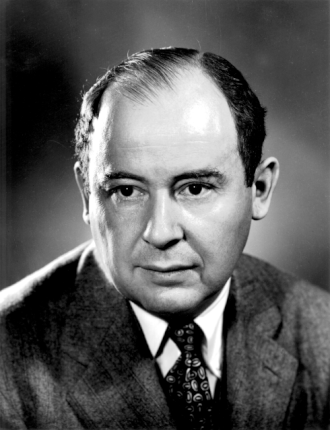 John von Neumann
"Children must be free to think in all directions irrespective of the peculiar ideas of parents who often seal their childrens minds with preconceived prejudices and false concepts of past generations. Unless we are very careful, very careful indeed, and very conscientious, there is still great danger that our children may turn out to be the same kind of people we are."