Quote
"The next grand extensions of mathematical physics will, in all likelihood, be furnished by quaternions."
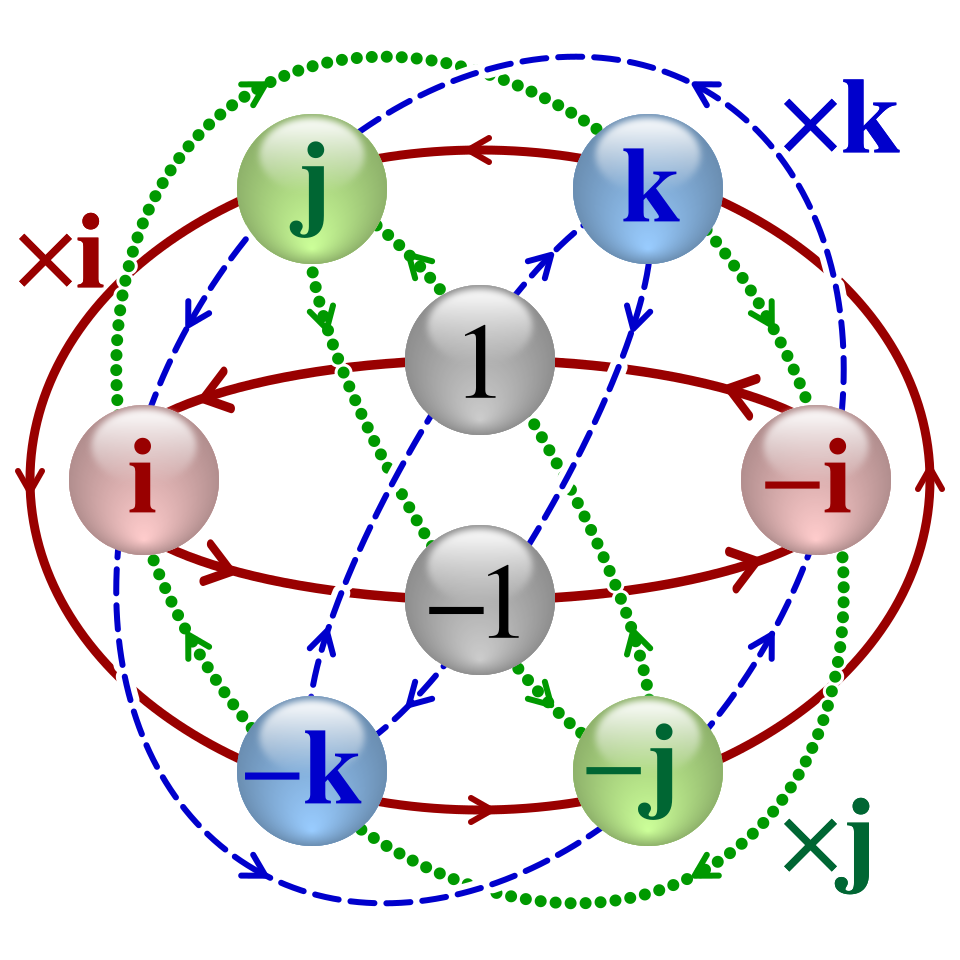 Quaternion
"[Q]uaternions form the appropriate algebraic basis for a description of nature whenever we have to deal either with pseudoreal group representations or with co-representations of Wigners Type II. The context in which quaternions arose historically, in a study of the three-dimensional rotation group, can now be seen to be an extremely special case of this general principle. Every group which admits pseudoreal representations equally admits a natural description in terms of real quaternions."
In mathematics, the quaternion number system extends the complex numbers. Quaternions were first described by the Irish mathematician William Rowan Hamilton in 1843 and applied to mechanics in three-dimensional space. The set of all quaternions is conventionally denoted by or by
"The next grand extensions of mathematical physics will, in all likelihood, be furnished by quaternions."
Quaternion"The real numbers are the dependable breadwinner of the family, the complete ordered field we all rely on. The complex numbers are a slightly flashier but still respectable younger brother: not ordered, but algebraically complete. The quaternions, being noncommutative, are the eccentric cousin who is shunned at important family gatherings. But the octonions are the crazy old uncle nobody lets out of the attic: they are nonassociative."
Quaternion"(1). The word "Quaternion" requires no explanation, since... it occurs in the Scriptures and in Milton. Peter was delivered to "four quaternions of soldiers" to keep him; Adam, in his morning hymn, invokes air and the elements, "which in quaternion run." The word (like, the Latin "quaternio," from which it is derived) means simply a set of four, whether those "four" be persons or things."
Quaternion"I do think... that you would find it would lose nothing by omitting the word "vector" throughout. It adds nothing to the clearness or simplicity of the geometry, whether of two dimensions or three dimensions. Quaternions came from Hamilton after his really good work had been done; and, though beautifully ingenious, have been an unmixed evil to those who have touched them in any way, including Clerk Maxwell."
Quaternion"[O]f possible quadruple algebras the one... by far the most beautiful and remarkable was practically identical with quaternions, and... it [is] most interesting that a calculus which so strongly appealed to the human mind by its intrinsic beauty and symmetry should prove to be especially adapted to the study of natural phenomena. The mind of man and that of Nature’s God must work in the same channels."
Quaternion"The familiar proposition that all A is B, and all B is C, and therefore all A is C, is contracted in its domain by the substitution of significant words for the symbolic letters. The A, B, and C, are subject to no limitation for the purposes and validity of the proposition; they may represent not merely the actual, but also the ideal, the impossible as well as the possible. In Algebra, likewise, the letters are symbols which, passed through a machinery of argument in accordance with given laws, are developed into symbolic results under the name of formulas. When the formulas admit of intelligible interpretation, they are accessions to knowledge; but independently of their interpretation they are invaluable as symbolical expressions of thought. But the most noted instance is the symbol called the impossible or imaginary, known also as the square root of minus one, and which, from a shadow of meaning attached to it, may be more definitely distinguished as the symbol of semi-inversion. This symbol is restricted to a precise signification as the representative of perpendicularity in quaternions, and this wonderful algebra of space is intimately dependent upon the special use of the symbol for its symmetry, elegance, and power."
Quaternion