SHAWORDS
Quaternion

Quaternion

Quaternion

Quaternion

author
25Quotes

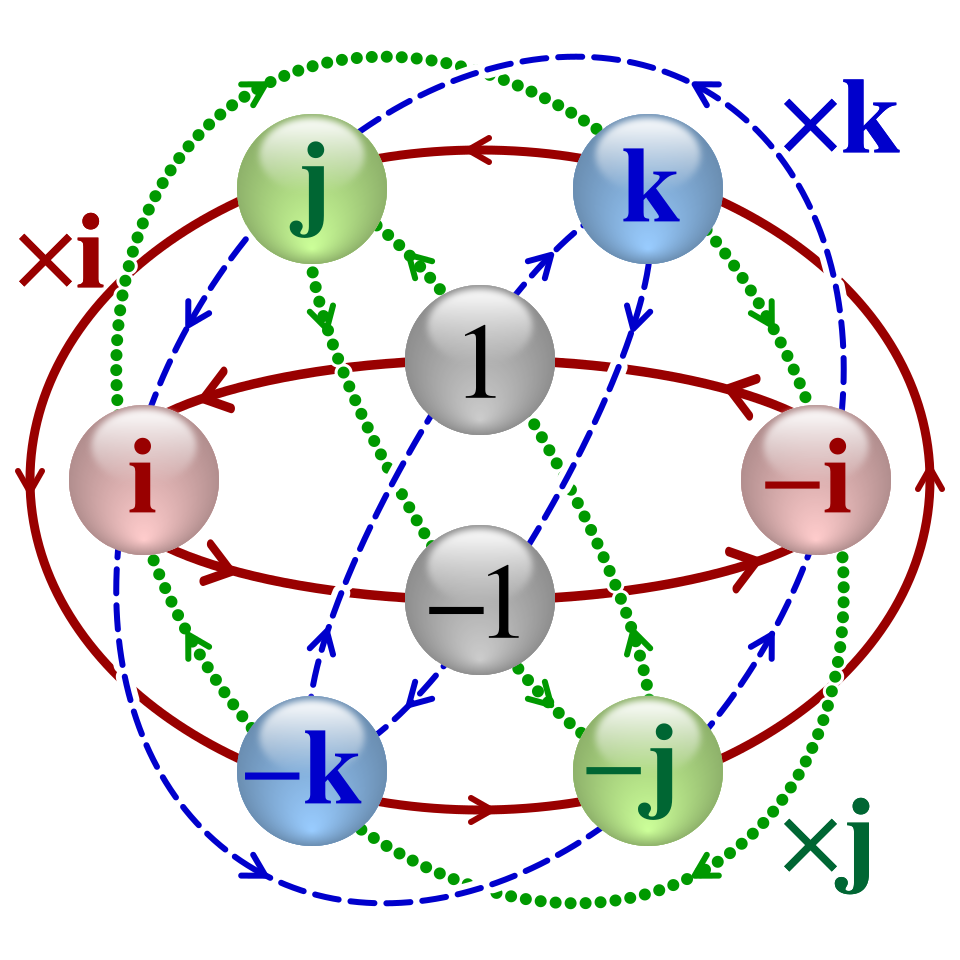
In mathematics, the quaternion number system extends the complex numbers. Quaternions were first described by the Irish mathematician William Rowan Hamilton in 1843 and applied to mechanics in three-dimensional space. The set of all quaternions is conventionally denoted by or by

Popular Quotes

25 total
Quote
"Prof. Tait has spoken of the calculus of quaternions as throwing off in the course of years its early Cartesian trammels. I wonder that he does not see how well the progress in which he has led may be described as throwing off the yoke of the quaternion. A characteristic example is seen in the use of the symbol ∇. Hamilton applies this to a vector to form a quaternion, Tait to form a linear vector function. ...Now I appreciate and admire the generous loyalty toward one whom he regards as his master which has always led Prof. Tait to minimise the originality of his own work in regard to quaternions and write as if everything was contained in the ideas which flashed into the mind of Hamilton at the classic . But... we owe duties to our scholars as well as to our teachers, and the world is too large, and the current of modern thought is too broad, to be confined by the ipse dixit [he says] even of a Hamilton"
QuaternionQuaternion
Quote
"[Q]uaternions form the appropriate algebraic basis for a description of nature whenever we have to deal either with pseudoreal group representations or with co-representations of Wigners Type II. The context in which quaternions arose historically, in a study of the three-dimensional rotation group, can now be seen to be an extremely special case of this general principle. Every group which admits pseudoreal representations equally admits a natural description in terms of real quaternions."
QuaternionQuaternion
Quote
"Yet, though few, if any—Clerk-Maxwell perhaps only excepted—ever possessed the same almost magical quality of physical insight, none could be more strict than Lord Kelvin in requiring demonstration freed from untenable assumptions or undemonstrable hypotheses. Daring as he was, at least in his earlier days, in the application of analytical methods to the phenomena of nature, he was in several ways very conservative. For example, he never would countenance the use in physics of the method of quaternions. At the British Association Meeting at Cambridge in 1845, he had met Hamilton, who there read his first paper on Quaternions. One might have thought that the young enthusiast would have readily welcomed a new and ingenious method of symbolic analysis: but it was not so. He would not use quaternion notation or quaternion methods himself, nor did he admit the into his work."
QuaternionQuaternion
Quote
"If I wished to attract the student of any of these sciences to an algebra for vectors, I should tell him that the fundamental notions of this algebra were exactly those with which he was daily conversant. ...I should call his attention to the fact that Lagrange and Gauss used the notation (αβγ) to denote precisely the same as Hamilton by his S(αβγ) except that Lagrange limited the expression to s, and Gauss to vectors of which the length is the secant of the latitude, and I should show him that we have only to give up these limitations, and the expression (in connection with the notion of geometrical addition) is endowed with an immense wealth of transformations. I should call his attention to the fact that the notation [r_1r_2], universal in the theory of orbits, is identical with Hamiltons V(\rho_1\rho_2) except that Hamilton takes the area as a vector... I confess that one of my objects was to show that a system of vector analysis does not require any support from the notion of the quaternion, or... of the imaginary in algebra."
QuaternionQuaternion
Quote
"(5). As early as the first book of Euclids Elements, an attentive student is (or may be) led to consider the relative length, and also the relative direction, of one straight line as compared with another. Thus when Euclid shows, in his very first proposition, how to construct on a given base AB an equilateral triangle ABC, he virtually teaches how, when one line AB is proposed or given, to draw a new line BC (or AC), which shall in length be equal to the given one, and in direction shall make with it an angle of sixty degrees, namely, the angle ABC (or BAC), which is the third part of 180 degrees, or of two right angles."
QuaternionQuaternion

Similar Authors & Thinkers



